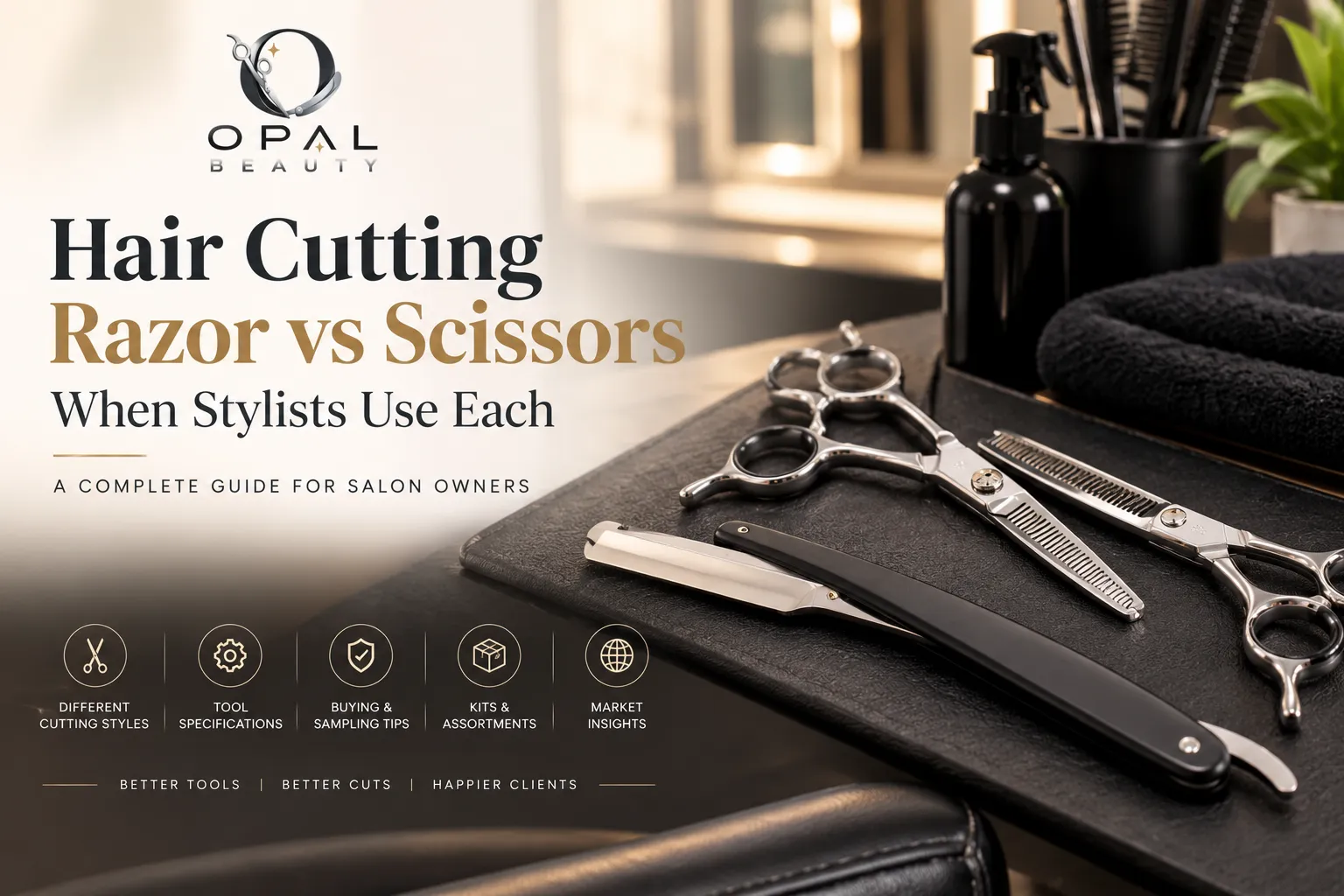

A stylist asked for a soft, lived-in cut and a stylist asked for a sharp, blunt bob reach for different tools. For a salon owner, barbershop, distributor, or private label brand, the hair cutting razor vs scissors question is also a buying question: which tools to stock, how to specify them, and how to build kits that fit how stylists really work.
This guide explains how razors and scissors cut differently, when stylists use each, what to specify on a razor order, and how to plan an assortment. It is written for the US market first and is useful for buyers in Canada, the UK, Europe, East Asia, and the Gulf, with a short section on market differences. General industry guidance is kept separate from what Opal Beauty states on its site.
How Razors and Scissors Cut Differently
What a Hair Cutting Razor Does
A hair cutting razor slices the hair at an angle, which tapers the ends instead of cutting straight across. The tapered ends overlap and sit softly, so razor work is associated with feathered layers, soft texture, and removing weight. The result depends on the blade, the angle, the pressure, and the stylist’s technique.
What Scissors Do
Scissors cut straight across the hair, so the ends are blunt and the weight stays at the perimeter. Scissors give stylists strong control over length and line, and with techniques such as point cutting or slide cutting they can also soften the ends. That versatility is why scissors are the first tool most stylists learn.
Razor vs Scissors Haircut: When Stylists Use Each
Tool choice follows the look, the hair, and the stylist’s training. The table shows common starting points, not rules.
| Goal or look | Common tool | Why |
| Blunt cut or one-length bob | Scissors | Clean, even perimeter with weight kept |
| Feathered layers, shags, soft edges | Razor | Tapered ends and visible movement |
| Removing bulk or weight | Razor or thinning shears | Reduces density without shortening length |
| Fine hair that needs fullness | Scissors | Keeps density at the ends |
| Curly or textured hair | Depends on the stylist | Technique matters more than the tool |
| Finishing and detailing | Either | Chosen by feel and preference |
Most real haircuts use more than one row of this table. A stylist may cut the perimeter with scissors, soften the interior with a razor, and finish with detailing, so the tools in a kit should work together instead of competing. That is also why buyers rarely need to pick a winner. They need a sensible mix.
Blunt Cut: Why Scissors Lead
A blunt cut is cut straight across at one length. It depends on a clean, even line, which is what scissors deliver best. A razor can shape a bob too, but it gives a softer edge, so most stylists choose scissors when the brief is crisp and structured. Our guide to barber scissors vs regular scissors explains what makes professional scissors suited to this work.
Soft, Textured Looks: Where Razors Lead
Shags, wolf cuts, and other airy styles often lean on a razor to taper and thin the ends. Many stylists also combine tools in one cut, using scissors for structure and a razor or thinning shear for texture. Our guide to thinning vs texturizing scissors covers the scissor-based alternatives.
Hair Type Considerations
Stylists weigh hair texture, density, and condition when choosing a tool. Fine or heavily processed hair may call for a gentler approach, while thick hair can benefit from weight removal. Curly hair is an area of active debate, and results depend on technique. Treat these as general observations, since stylist preference and training vary, and this article does not offer hair-care advice.
Training and Usage Guidance
Razors take practice, and results depend on training. Stylists and academies often teach the technique before a student uses a razor on a client. If you sell razors, include a simple usage and safety leaflet with each pack, and point customers to the manufacturer’s instructions and to qualified training. This article does not teach cutting technique, and brands should avoid promising results in their own marketing.
Types of Razors Stylists Use
Straight Razor for Hair Cutting
A straight razor for hair cutting has a blade fixed in or held by a handle. Many professional razors use replaceable blades. Stylists and barbers use them for cutting, tapering, and detail work. Rules on blade use, replacement, and disposal differ by region, so follow local regulations and the manufacturer’s instructions.
Hair Shaper and Styling Razors
A hair styling razor, or styling razor for hair, is built for texturizing and shaping, and some models include a guard. The category is sold under several names, including hair shaper razor, so confirm the exact design from a photo and spec before ordering.
Texturizing Razors vs. Thinning Shears
A texturizing razor or hair texturizing razor and a thinning shear both reduce bulk and add texture, but they work differently. A razor tapers the ends, while a thinning shear removes hair at intervals using teeth. Buyers often stock both so stylists can pick by technique.
Specifying a Razor
A razor spec should state the handle shape and length, how the blade is held and replaced, and whether a guard is included. Give dimensions in millimeters with inches in brackets for US buyers.
Blade Fit and Replacement
Ask which blades fit the razor, how they are replaced, and whether the supplier can provide compatible blades. A razor that is hard to load invites handling accidents.
Test the Blade Seat
Load a blade as the manufacturer instructs and check that it sits securely with no wobble or shifting. Handle all blades with care.
Kits and Assortments: Pairing Razors With Scissors
Razors and scissors are often sold together, so a kit has to make sense as a set. Opal Beauty’s razor and thinning shear sets page describes matching razors and shears in kits with custom cases, and its hairdressing scissors page lists its cutting scissors. Our guide to types of hair scissors helps with the scissor side.
- Barbershop or salon: scissors for structure, plus a razor and thinning shear for texture.
- Academy or student kit: a simple, matched set with clear care guidance.
- Distributor: loose razors, scissors, and shears so customers can build their own mix.
- Private label brand: one hero kit first, then expand once it sells.
Common Mistakes When Buying Razors and Scissors Together
- Treating them as interchangeable: a razor and a scissor serve different looks, so stock both on purpose.
- Ordering by title alone: razor names vary, so check the design, blade system, and guard from photos and specs.
- Skipping the blade question: ask which blades fit and whether replacements are easy to source.
- Ignoring handle and tension matching in kits: a set should feel consistent across tools.
- Branding before approving samples: logo placement should follow sample sign-off.
- Assuming one market’s habits apply everywhere: test names, kits, and finishes with local partners.
Safety, Blade Handling, and Care
Razor blades are sharp and need careful handling. Ask the manufacturer for written instructions on loading, replacing, and disposing of blades, and for care instructions for the handle. Scissors need regular cleaning, oiling, and tension checks, and our professional hair cutting scissors buying guide covers what to check when choosing them. Rules for cleaning, disinfection, and blade disposal differ by country and region, so confirm them locally and avoid hygiene claims in your own marketing.
Razor vs Scissors Across Markets
Tool preferences and expectations differ by market. The notes below are general observations, not rules, so test with local partners before you commit to a range.
- United States and Canada: buyers often look for versatile kits that suit both barbering and salon work. See the USA and Canada market pages.
- United Kingdom: buyers may ask for clear product naming and care guidance. See the UK page.
- Germany, France, and Italy: craft traditions in barbering and hairdressing mean buyers may scrutinize finish and construction closely. See the pages for Germany, France, and Italy.
- Japan, South Korea, and China: stylists in these markets are often associated with detailed, texture-focused cutting, so razor and shear options may draw interest. See Japan, South Korea, and China.
- Saudi Arabia and the UAE: barbering and grooming are a strong part of the professional scene, and buyers may weigh presentation and kit packaging. See Saudi Arabia and the UAE.
Naming also shifts between markets, so check that your product names match what local customers search for.
Sourcing Razors and Scissors From a Factory-Direct Manufacturer
Buyers ordering from overseas ask about samples, design approval, batch-to-batch consistency, packaging, shipping, and customs. Settle them in writing before production. Import and compliance requirements differ by country and change over time, so confirm them locally.
Opal Beauty is a factory-direct manufacturer in Sialkot, Pakistan, with wholesale and bulk supply for brands and distributors, and private label and custom branding. Its razor page mentions professional straight razors and blade replacement, but does not describe hair shaper or texturizing razors, so ask which razor types are available. Use our quality control checklist to plan sample approval.
What to Include in Your Quote Request
- Razor type, handle, blade system, and any guard
- Scissor or shear type, size, and edge style
- Kit contents, case, and branding files
- Quantity, destination country, and delivery window
Request a quote with those details so the first sample starts from a clear specification.
Frequently Asked Questions
Is a razor better than scissors for hair cutting?
Neither is better overall. Razors suit tapered, textured looks and scissors suit blunt, structured ones. Many stylists use both in one cut.
Can a razor give a blunt cut?
A razor gives a softer, tapered edge, so most stylists choose scissors for a blunt cut.
What is a texturizing razor?
It is a razor designed to taper and thin the hair to add texture and remove weight. Confirm the exact design from a photo and spec.
Do stylists need both a razor and scissors?
Most professionals benefit from both, since they serve different looks. The right mix depends on the services offered.
Does Opal Beauty make hair shaper razors?
Its site lists professional straight razors, not hair shaper or texturizing razors. Ask in your quote.
Final Thoughts: Stock the Tools That Match the Look
Choose by the look the stylist wants to create: scissors for structure, razors and shears for texture, and both for most professional kits. Specify each tool clearly, sample before you buy in bulk, and check local rules on blades and care.