
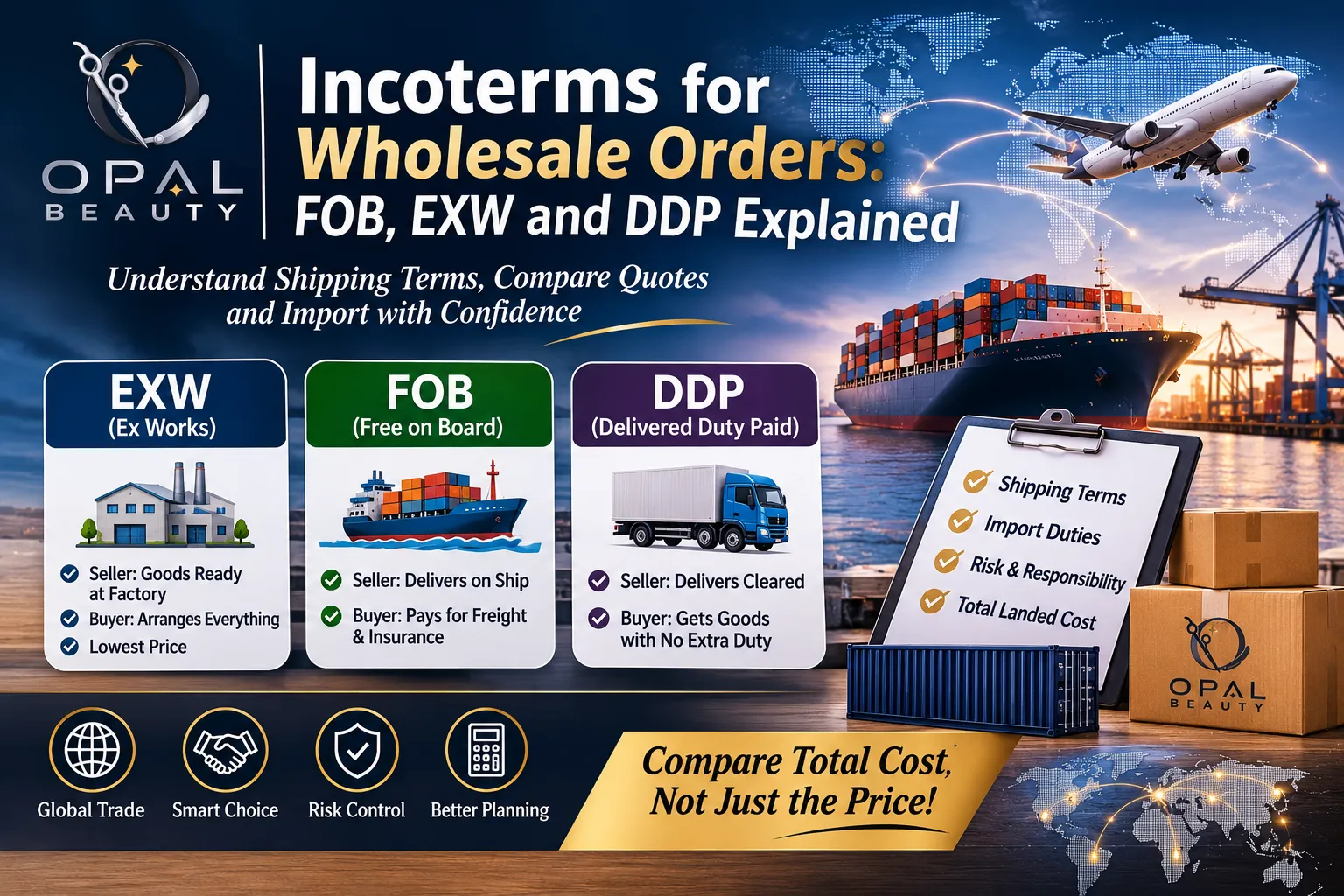

When a wholesale quote says “FOB,” “EXW,” or “DDP,” it is answering a question the price alone does not: who does what, who pays for what, and who carries the risk at each stage of the journey? This guide explains FOB vs EXW and how DDP differs, which term suits which buyer, and how to compare quotes on total cost. It is written for importers, first-time wholesale buyers, and procurement teams ordering beauty tools from a manufacturer in Pakistan, with a US buyer as the main example.
It is general information based on the Incoterms 2020 rules, not legal or logistics advice. Your forwarder, broker, and contract decide the details. General guidance is kept separate from what Opal Beauty states about its own process.
What Incoterms Do and Do Not Cover
Incoterms are standard trade terms published by the International Chamber of Commerce. Each one is a short code, such as FOB, that is paired with a named place, and it sets out three things: where the seller’s delivery ends, who pays for which part of transport and clearance, and where risk passes from seller to buyer.
They do not set the price, the payment terms, or when ownership of the goods transfers, and they do not replace a written contract. Think of an Incoterm as the shipping section of your agreement, not the whole agreement.
The Terms You Will See Most
| Term | Works for | In short |
| EXW (Ex Works) | Any transport mode | Seller makes goods available at its premises; buyer arranges everything else |
| FCA (Free Carrier) | Any transport mode | Seller delivers to the buyer’s carrier at a named place and clears export |
| FOB (Free on Board) | Sea and inland waterway | Seller loads goods on the vessel and clears export; risk passes on board |
| CIF (Cost, Insurance and Freight) | Sea and inland waterway | Seller pays sea freight and minimum insurance; risk still passes at loading |
| DAP (Delivered at Place) | Any transport mode | Seller delivers to a named place; buyer clears import and unloads |
| DDP (Delivered Duty Paid) | Any transport mode | Seller delivers cleared for import and pays duty |
FOB vs EXW: The Core Differences
The two terms differ mainly in where the seller’s work stops.
| Responsibility | EXW | FOB |
| Packing for export | Seller | Seller |
| Loading at the factory | Buyer | Seller |
| Transport to the port | Buyer | Seller |
| Export clearance | Buyer | Seller |
| Loading on the vessel | Buyer | Seller |
| Main freight | Buyer | Buyer |
| Risk passes to buyer | At the seller’s premises | When goods are on board |
| Import clearance and duty | Buyer | Buyer |
EXW: Lowest Quote, Most Work
Under EXW, the supplier’s job ends when the goods are ready at its door. The quote looks lowest because it leaves out trucking, export clearance, and port handling, but you or your forwarder must arrange them, usually in a country you do not work in. Export clearance can also be hard for a foreign buyer to organize without a local agent. EXW can make sense if you already have a forwarder with a team at the origin, or if you are consolidating goods from several factories.
FOB: A Common Starting Point
Under FOB, the factory delivers the goods on board the vessel at the named port and handles export clearance. You take over from there: ocean freight, insurance, import clearance, and delivery. Because the quoted price already includes origin costs, FOB quotes from different suppliers are easier to compare. Many first-time buyers start here, but it is not the only sound choice, as the buyer table below shows.
FOB has two limits. It is for sea freight only, so air shipments usually use FCA. And for goods packed into containers, the ICC recommends FCA over FOB, because the goods are handed to a terminal before they are actually loaded on the ship. Many suppliers still quote “FOB” for container shipments, so confirm what the quote covers.
Name the Port Precisely
An Incoterm is only meaningful with a named place. A factory in an inland city such as Sialkot is not at a port, so a quote of “FOB Sialkot” leaves the delivery point unclear. Ask for the actual port, for example “FOB” followed by the port in Karachi, and “Incoterms 2020.”
Write It the Same Everywhere
Use the same term, place, and rules version on the proforma invoice, purchase order, and commercial invoice.
Check for Mismatches
A quote that says FOB while the invoice says something else is a warning sign. Ask the supplier to correct it before you pay a deposit.
DDP Explained: One Price, More Questions
DDP, or delivered duty paid, puts the most work on the seller. The seller arranges transport to the named destination, clears the goods for import, and pays the duty, so the buyer mainly receives and unloads. For wholesale buyers, that can mean one all-in price and one party to call. It is common to see DDP quotes for small courier shipments of samples or small orders.
The catch is practical. Import clearance is a local process, and a factory overseas often cannot act as importer of record in the buyer’s country, so DDP usually runs through a forwarder or partner. That makes the quote harder to check. A DDP price may also hide freight, duty, and fees you would otherwise see.
Questions to Ask Before Accepting a DDP Quote
- Who is the importer of record, and whose name goes on the customs entry?
- Does the price include duty, taxes, brokerage, and delivery, and any additional tariffs?
- Who is the forwarder or partner, and do you get the customs documents?
- Who is responsible if customs holds or examines the shipment?
- How does the all-in price compare with FOB plus your own freight and broker costs?
DAP is a close cousin: the seller delivers to the destination, but you handle import clearance and duty. Many buyers prefer it for exactly that reason.
Which Term Suits Which Buyer?
Advice differs between forwarders, so treat this as general guidance, not a rule.
| Situation | Terms to consider |
| First sea-freight order, you will hire your own forwarder | FOB, with a named port |
| Air freight or containerized cargo | FCA |
| Experienced buyer with an agent at the origin | EXW, if the agent handles export clearance |
| Small sample or courier order, want one invoice | DAP or DDP, after checking the questions above |
| Established buyer who wants one all-in price | DDP, with a verified forwarder |
Some forwarders recommend DDP for small importers because it gives one party and one bill, while others prefer FOB because it keeps freight visible and comparable. Neither is wrong. What matters is knowing what each price includes. Our guides to low-MOQ private label and common private label mistakes explain how order size and planning interact with shipping.
A Simple Landed-Cost Example
Landed cost calculation means adding every cost to get the goods to your door. The numbers below are hypothetical round figures for a 2,000-piece order. They are not market rates, freight quotes, or Opal Beauty prices. Duty and import fees are the same under both terms, so they are left out here to show the difference between the two quotes. Add them using figures confirmed by your broker.
| Cost item | EXW quote | FOB quote |
| Goods | $4,000 | $4,400 |
| Trucking to port | $150 | included |
| Export clearance | $100 | included |
| Port handling and loading | $100 | included |
| Ocean freight | $600 | $600 |
| Cargo insurance | $40 | $40 |
| US customs broker | $200 | $200 |
| Delivery to your warehouse | $250 | $250 |
| Total (before duty and fees) | $5,440 | $5,490 |
The EXW quote looked $400 cheaper, but the total difference is only $50, and EXW also brought extra coordination. The lesson is to compare totals, not unit prices, and to ask what each quote leaves out. A DDP quote should be compared the same way: against FOB plus your own freight, duty, and broker costs.
Insurance, Risk, and Damage
Under EXW the risk passes at the seller’s door, and under FOB it passes when the goods are on board. After that point, damage in transit is the buyer’s risk unless you have insurance. Of the common terms, only CIF and CIP oblige the seller to arrange insurance, and only at a stated minimum level. Under FOB and EXW, buyers usually arrange their own cargo insurance. Check what any policy covers and who the claimant is.
Writing Incoterms Into Your Quote, PO, and Invoice
- Use the term, the named place, and “Incoterms 2020” together
- Ask the supplier to list what the price includes and excludes
- Get freight and brokerage quoted separately by your own forwarder
- Keep the term identical on the proforma invoice, PO, and commercial invoice
- Allow for production and shipping time when you set dates. Our production timeline guide helps with this.
Our guide to importing beauty tools from Pakistan covers the documents and duties that sit beside these terms.
Incoterms Across Markets
The terms are the same worldwide, but the import side differs by country. US buyers can start with the USA beauty instrument supplier page and plan around a broker and bond. Buyers in the UK, Germany, France, and Italy often ask for DAP or DDP-style quotes, but import tax and registration rules matter. Buyers in Canada, Japan, South Korea, China, Saudi Arabia, and the UAE should check local clearance requirements with a local broker. These are general observations, not rules, and requirements change over time.
Working With Opal Beauty on Shipping Terms
Opal Beauty is a factory-direct manufacturer in Sialkot, Pakistan, with wholesale and bulk supply for brands and distributors. Its site says it provides the documentation needed for international shipping and works with established international logistics providers. It does not state which Incoterms it quotes, so ask the team directly, and confirm the named port, what the price includes, and who prepares each document. Use our quality control checklist to plan sample and pre-shipment checks.
What to Include in Your Quote Request
- Products, quantities, and finishes
- Your preferred Incoterm, such as FOB or FCA, and the named port
- Sea, air, or courier, and your target delivery window
- Whether you want the supplier to quote freight, or only the goods
- Documents you need, such as commercial invoice and packing list
Request a quote with those details so the price and the shipping term are agreed together.
Frequently Asked Questions
Is FOB or EXW better for a small importer?
FOB is a common starting point because the factory handles export logistics and the price is easier to compare. EXW can work if you have an agent at the origin. Compare total costs, not just the unit price.
Can I use FOB for air freight?
FOB is a sea and inland waterway term, so air shipments usually use FCA. Containerized cargo is also often better suited to FCA.
Does the Incoterm change the import duty?
The Incoterm does not change the tariff rate, which depends on classification and customs value. It changes who pays for freight and origin costs, and what the quote includes.
Who is the importer of record under DDP?
It depends on the arrangement, and it is the most important question to ask. Make sure it is clear whose name is on the customs entry before you accept a DDP quote.
What does “FOB” plus a port name mean in a quote?
It means the seller delivers the goods on board the vessel at that port and clears them for export. Your costs and risk start from that point.
Final Thoughts: Compare Total Cost, Not the Headline Price
Pick the Incoterm that matches your experience and your shipping plan, name the place, and write the term into every document. Then compare quotes on total landed cost. A clear shipping term prevents most surprises after the deposit is paid.