
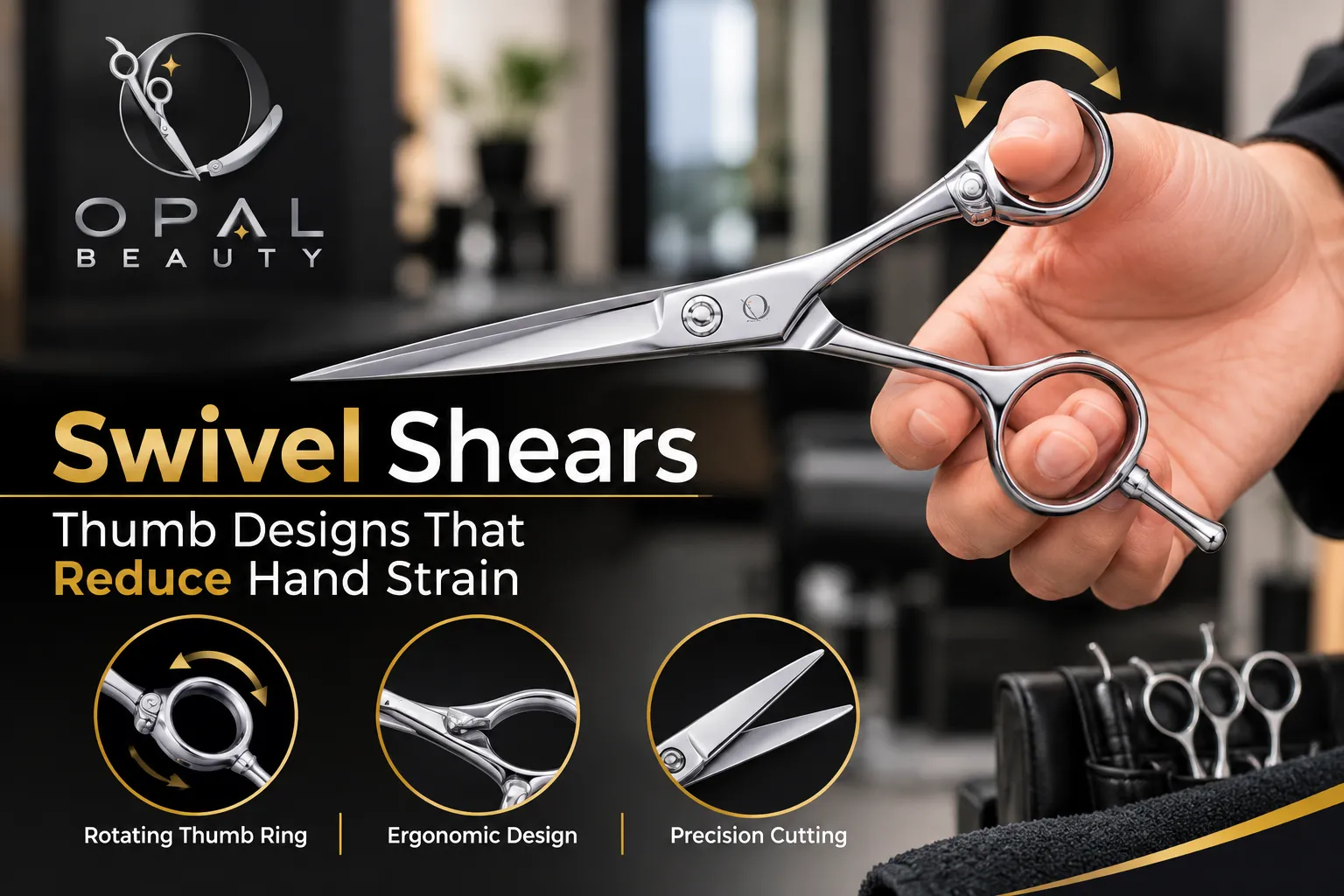

Cutting hair means thousands of small opening and closing movements a day, and the thumb ring is where the hand meets the tool. Swivel shears, also called swivel thumb shears or swivel hair scissors, put that ring on a joint so it can rotate. Some stylists find that this lets the thumb, wrist, and elbow settle into a more natural position. This guide explains how swivel shears work, what they can and cannot claim, how they differ from offset and crane handles, and what brands and distributors should specify before they add one to a range.
It is general information for stylists, barbers, distributors, and brands, not medical advice. General industry guidance is kept separate from what Opal Beauty states on its site.
What Swivel Shears Are
How the Rotating Thumb Works
A swivel shear has a thumb ring that rotates on a pivot, instead of being fixed to the handle. As the hand opens and closes the blades or changes cutting angle, the ring can turn with the thumb. With a fixed ring, the wrist and forearm may do more of that adjusting. The blades, edge, and tension system are separate from the swivel, so the swivel changes how the tool sits in the hand, not how the blades cut.
Single vs. Double Swivel
Single-swivel designs add one rotating connection and tend to feel more guided. Double-swivel designs add a second connection for a wider range of thumb movement and a looser feel. Names and mechanisms vary by maker, so ask exactly what a product offers before you buy or list it.
Do Swivel Shears Reduce Hand Strain?
Sellers often say yes, and some go further than they should. Here is a more careful answer. Swivel shears may help some stylists by reducing thumb extension, wrist rotation, or a raised elbow during work at changing angles. How much they help depends on shear size, finger-ring fit, grip, technique, workstation height, and how many cuts a stylist does each day. They are not guaranteed to prevent or treat pain or injury, and no handle is a medical device.
For brands, this matters in marketing. Describe what the mechanism does, such as a rotating thumb ring, and avoid claims about preventing carpal tunnel syndrome or similar conditions. A stylist with persistent pain, numbness, or tingling should see a qualified healthcare professional, not rely on a change of shears.
Wording for Product Pages
Clear, factual wording protects a brand. Examples of safer phrasing are “rotating thumb ring,” “designed to let the thumb move more freely,” and “available in single and double swivel.” Phrases to avoid include “prevents carpal tunnel,” “cures wrist pain,” and “doctor recommended,” unless you hold documentation and the claim is allowed where you sell. Rules on health claims differ by country, so check them locally.
Swivel vs. Offset vs. Crane: Different Questions
These terms are often treated as rivals, but they answer different questions.
| Feature | What it changes | Notes |
| Swivel | Whether the thumb ring rotates | Can be combined with other handle styles |
| Offset | Where the thumb ring sits relative to the finger ring | Fixed thumb in most designs |
| Crane | A more pronounced angle of the thumb ring | Often described as lowering the elbow |
A shear can be offset and still have a fixed or a swiveling thumb, so compare these features separately, along with blade, length, and tension. Our professional hair cutting scissors buying guide covers offset and straight handles, and our guide to types of hair scissors explains how handle and blade choices affect technique.
Who May Prefer Which
These are tendencies, not rules. Stylists who feel thumb tension or who often change cutting angles may want to trial a swivel. Those who like firm, consistent thumb feedback and mostly structured cutting may prefer a fixed ring. Many stylists keep both and use each for different work. Since fit and technique matter more than the handle name, the most reliable test is working with a pair for a full session.
What to Check on a Swivel Shear
Swivel Mechanism
Not every swivel joint is built the same, so ask for detail.
Rotation and Wobble
The ring should rotate smoothly, with light and even resistance and no side-to-side play.
Retaining Screw and Serviceability
Ask whether the joint has a secure retaining screw, whether it can be cleaned and adjusted, and whether replacement parts are available.
Test It Through a Working Session
A few openings at a counter will not show how the mechanism feels after several appointments. Have a stylist use a sample for a full session and report back.
Ring Fit and Finger Inserts
The thumb ring should fit the thumb without pinching or sliding too deep. Many makers offer finger inserts or sizers. Check ring dimensions in millimeters, and ask which insert sizes are available.
The Blade Comes First
A comfortable handle on a poor blade is not a good tool. Check blade alignment, edge, and tension separately. If a supplier adds a swivel but does not control the blade, you get comfort without cutting quality.
Weight and Balance
A heavier shear can tire the hand even with a good handle. Ask for weight, and check balance around the pivot.
Common Mistakes When Buying Swivel Shears
- Choosing by the handle alone: a swivel on a weak blade is not a good tool.
- Treating swivel, offset, and crane as the same choice: they change different things.
- Skipping a full-session trial: a quick test does not show how the mechanism feels later in the day.
- Ignoring the joint’s serviceability: a joint that cannot be cleaned or adjusted becomes a problem over time.
- Forgetting the ring size: a ring that is too large or too small spoils the benefit.
- Making medical claims: describe the mechanism and leave the health claims out.
- Assuming every model is available left-handed: ask before you plan a range.
Learning Curve and Adoption
Swivel shears take some getting used to. Many stylists describe an adjustment period of days to a couple of weeks, but it varies. A common tip is to keep the thumb relaxed and not too deep in the ring, and to start with familiar cuts. For brands and distributors, a short how-to-hold card in each pack can improve first impressions. Follow the manufacturer’s instructions, and do not promise results.
Care and Maintenance of Swivel Shears
The rotating joint is one more part to look after. Wipe hair and product from the joint and blades after use, apply a little scissor oil as the maker advises, check tension regularly, and store shears in a case. When shears go for sharpening, ask the service to inspect the swivel joint too. Our scissor sharpening and care guide explains why sharpening is best left to a specialist or the manufacturer. Rules for cleaning and disinfection differ by region, so follow local regulations.
Range Planning for Brands and Distributors
These are starting points, not rules.
- Core range: a fixed-ring cutting shear and one swivel option in the same blade and size.
- Handle options: offset or crane, with single or double swivel as an add-on.
- Fit options: a few finger-insert sizes in each pack.
- Left-hand versions: where available, treat them as true left-handed designs, not reversed handles.
- Kits: pair a swivel cutting shear with a matching blending shear.
Write the description by what the mechanism does, and test with working stylists before launch.
Swivel Shears Across Markets
Stylists in many markets want comfort over long days. US buyers can start with the USA beauty instrument supplier page and Canada buyers with theirs. In the UK, Germany, France, and Italy, ergonomic expectations may be similar, but product naming and claims rules can differ, so check local requirements before you market comfort benefits. In Japan, South Korea, and China, buyers may look closely at the precision of the mechanism and the finish. In Saudi Arabia and the UAE, presentation and kit packaging may matter. These are general observations, not rules.
Sourcing Swivel Shears From a Factory-Direct Manufacturer
Opal Beauty is a factory-direct manufacturer in Sialkot, Pakistan, with wholesale and bulk supply and private label and custom branding. Its hairdressing scissors page lists offset and crane handle layouts and describes them as ergonomic. It does not list swivel-thumb shears, so ask whether a swivel option is available, in single or double form, before you plan a range around one. Use our quality control checklist to plan sample approval, and include the swivel joint in your checks.
What to Include in Your Quote Request
- Shear type, blade length, and edge style
- Handle style: offset, crane, or other
- Swivel type: none, single, or double, and ring size or insert options
- Care guidance and spare parts you need
- Branding, packaging, quantity, and delivery window
Request a quote with those details so the mechanism is specified clearly.
Frequently Asked Questions
What are swivel shears?
Hair-cutting shears with a thumb ring that rotates on a joint, so the thumb can move more freely during cutting.
Do swivel shears prevent carpal tunnel syndrome?
No handle can promise that. Swivel shears may help some stylists by reducing awkward thumb and wrist positions, but they are not a medical device. Persistent pain or numbness should be checked by a healthcare professional.
Are swivel shears hard to use?
They take some adjustment. Many stylists describe days to a couple of weeks, and it varies by person and technique.
What is the difference between single and double swivel?
Single swivel adds one rotating connection, and double swivel adds a second for more movement. Mechanisms vary by maker, so ask for details.
Does Opal Beauty make swivel shears?
Its site lists offset and crane handles, not swivel-thumb shears. Ask in your quote.
Final Thoughts: Specify the Mechanism, Not the Promise
Swivel shears are a handle option, not a cure. Judge them by the smoothness and stability of the joint, the ring fit, the blade, and the balance, and test them through a real working session. Describe what the mechanism does, avoid medical claims, and let stylists decide by how the shear feels at the end of the day.