
A left-handed stylist who trains with right-handed scissors often struggles with a pair that never quite closes cleanly, and it is not a technique problem. Left handed hair scissors are built differently from right-handed ones, and the difference sits in the blades as much as in the handles. This guide explains what makes a pair truly left-handed, how it differs from converted or reversed-handle designs, what to check before buying, and how brands and distributors can add left-hand versions to a range.
It is general information for stylists, barbers, distributors, and brands, not medical advice. General industry guidance is kept separate from what Opal Beauty states on its site.
True Left-Handed Scissors vs. Converted Scissors
What Makes a Pair Truly Left-Handed
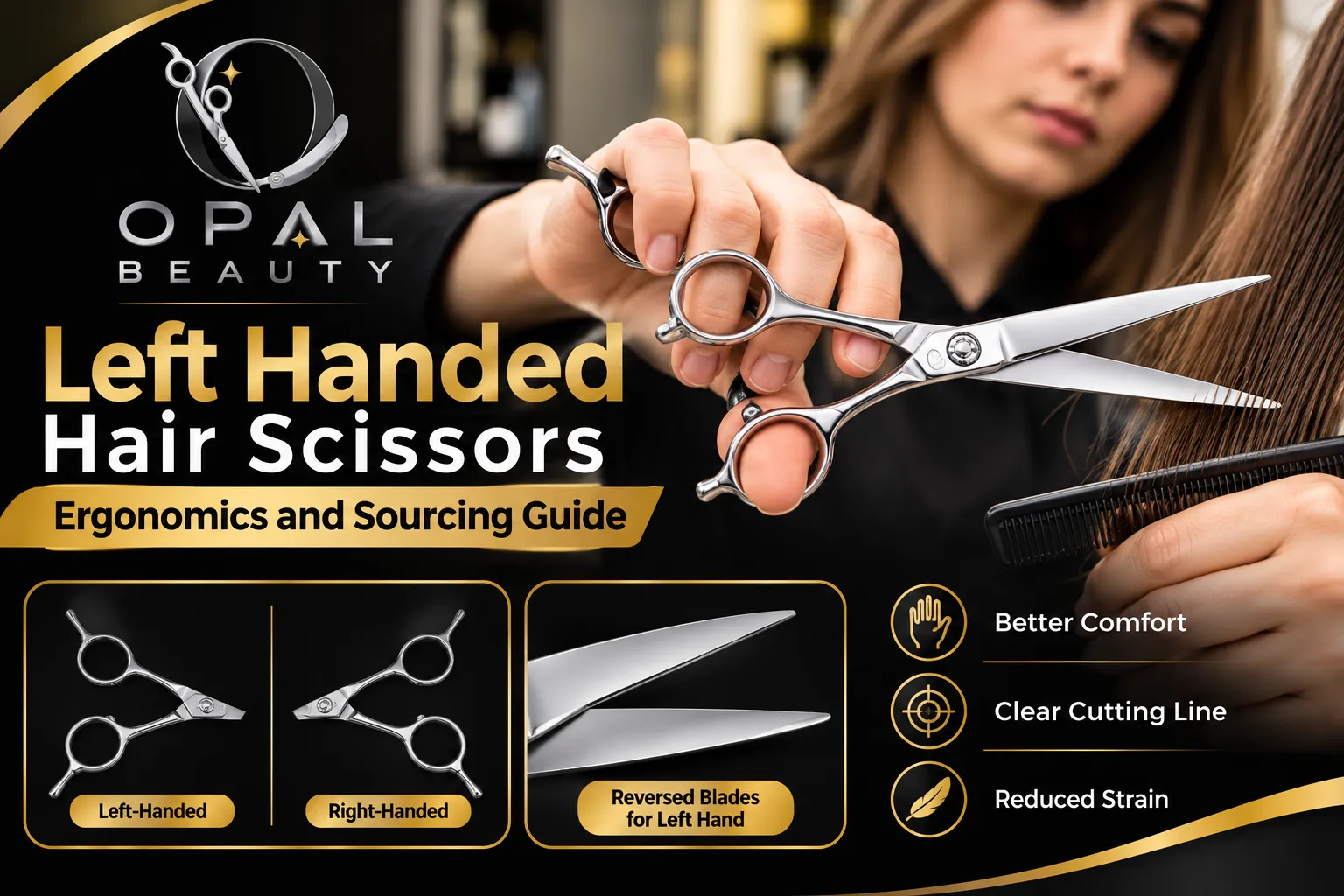
True left hand hair scissors are a mirror image of a right-handed design, not a right-handed pair turned over. The blades are reversed, so the squeeze of the left hand closes them together. The handles are shaped for the left hand, and the tension screw and pivot are arranged to match. The result is a pair that cuts cleanly when it is squeezed and lets the stylist see the cutting line. This is what people mean by mirrored blade geometry.
Why a Right-Handed Pair Works Against a Left Hand
Many sources describe the same problem. In a right-handed pair held in the left hand, the natural squeeze can push the blades apart, so hair can fold or slide instead of cutting. The top blade can also block the view of the cutting line. Stylists may compensate by gripping harder or holding the pair at an awkward angle, which makes work more tiring. Skilled stylists adapt to right-handed tools over the years, but that is a workaround, not a design benefit.
Converted, Reversed-Handle, and “Ambidextrous” Pairs
Some products are sold as left-handed when only the handles are changed. Others are marketed as ambidextrous, usually with symmetrical handles that can be held in either hand. If the blades are still ground for a right hand, the same cutting problem can remain. Always ask the maker whether the blades themselves are reversed.
| Feature | True left-handed | Converted or reversed-handle |
| Blades | Reversed, mirrored geometry | Right-handed geometry |
| Handle | Shaped for the left hand | Often reversed only |
| Tension and pivot | Arranged for the left hand | May be unchanged |
| Cutting line | Clear to the left-handed user | May be blocked |
Ergonomics for Left-Handed Stylists
Handle and Ring Fit
Handle styles such as offset and crane are explained in our guide to types of hair scissors, and the same principles apply to the left hand. What changes is the shaping. An ergonomic handle for the left hand has the ring and finger rest shaped for the left thumb and fingers. Check ring size in millimeters, ask about finger inserts, and have a left-handed stylist try samples.
Size and Weight
Left-handed scissors usually come in the same size ranges as right-handed ones, but fewer sizes may be offered in the left-handed version. A stylist may need to accept a size a little longer or shorter than ideal. Our professional hair cutting scissors buying guide explains how to choose length and weight, and our guide to scissor-over-comb cutting shows how technique affects the size a stylist prefers.
Scissors for Left Handed Stylists, Not Just “Left-Handed Handles”
Ergonomic claims should be described carefully. A well-fitted pair may reduce awkward positions for some stylists, but no handle is a medical device, and comfort depends on fit, technique, and workload. Brands should describe the design and avoid health claims. A stylist with persistent pain, numbness, or tingling should see a healthcare professional.
Learning and Training
Left-handed students are often taught by right-handed educators, so they may mirror a technique while also working with a pair that was never built for them. Schools and academies can help by offering true left-handed pairs in student kits and by letting instructors demonstrate with a mirrored grip. Left-handed stylists who share a station should keep their own pair in a clearly marked case, so nobody borrows it and assumes it is faulty.
How to Check a Left-Handed Pair Before You Buy
Verifying Blade Orientation
Visual Check
Ask for clear photos and a description of the blades, and ask the maker to confirm that the blades are reversed, not just the handles.
Cutting Check
Have a left-handed stylist cut hair with the pair. It should cut cleanly when squeezed, without folding or pushing the hair.
Ask a Left-Handed Stylist
Test samples through a working session, since a quick trial at a counter can miss problems. Record the stylist’s feedback with your specification.
Tension, Pivot, and Finish
The tension screw should adjust smoothly, the blades should close without catching, and the finish should be free of burrs. Compare several units of the same model with each other and with your approved reference.
Adding Left-Hand Versions to a Range
For a brand or distributor, a left-hand version is a separate product, not a mirrored photo.
- Separate tooling: reversed blades need their own grinding and checks, so confirm with the factory how they are made.
- Separate SKUs: list each size and handle in each hand as its own SKU.
- Clear marking: mark the hand on the product, the packaging, and the listing, so right-handed buyers do not order the wrong pair.
- Start narrow: begin with your best-selling size and handle in each hand, then add more.
- Sample first: approve a left-hand sample with a left-handed stylist before a bulk order.
- Plan for care: confirm that your service or sharpening partner can handle left-handed geometry.
Naming and Listing
Buyers search with different words: left handed hair scissors, lefty hair scissors, left-handed hairdressing scissors, southpaw hair shears, and left handed shears for hairdressers. Use the term your market uses, and state in the description that the blades are reversed, if they are. Avoid vague phrases like “suitable for lefties” when the product is only reversed at the handle.
Range Planning by Buyer Type
These are starting points, not rules.
- Salon or shop: one or two left-handed cutting pairs per left-handed stylist, labeled and stored separately.
- School or academy: left-handed options in student kits, in the sizes the course uses.
- Distributor: a small left-hand range alongside the right-hand line, with clear marking and a simple size chart.
- Brand: left-hand versions of the best-selling model first, then more sizes as demand shows.
Sharpening and Care for Left-Handed Scissors
Care is the same in principle: wipe and dry the blades, oil the pivot, check tension, and store the pair in a case. Sharpening needs more care, because reversed geometry should be restored as designed. Ask any service whether it handles left-handed pairs, and follow the manufacturer’s guidance. Our scissor sharpening and care guide explains why professional scissors are best sharpened by a specialist or the manufacturer. Rules for cleaning and disinfection differ by region, so follow local regulations.
Common Mistakes When Buying Left-Handed Scissors
- Assuming reversed handles mean left-handed blades: ask the maker.
- Choosing “ambidextrous” for a left-handed stylist: symmetrical handles do not change the blade geometry.
- Ordering by size alone: fewer sizes exist in the left-handed version.
- Skipping a left-handed tester: a right-handed buyer may not spot the problem.
- Mixing hands in the packaging: unclear marking leads to returns.
- Ignoring sharpening support: not every service handles left-handed pairs.
- Making health claims: describe the design and leave medical claims out.
Left Handed Hair Scissors Across Markets
Left-hand tool demand is global, so keep the approach neutral. US buyers can start with the USA beauty instrument supplier page and Canada buyers with theirs. In the UK, “hairdressing scissors” is a common term, so check which names local buyers search for. Buyers in Germany, France, and Italy may use their own terms, and in Japan, South Korea, and China, buyers may look closely at blade precision. In Saudi Arabia and the UAE, presentation and clear product marking may matter. These are general observations, not rules.
Sourcing Left-Handed Scissors From a Factory-Direct Manufacturer
Opal Beauty is a factory-direct manufacturer in Sialkot, Pakistan, with wholesale and bulk supply and private label and custom branding. Its hairdressing scissors page lists offset and crane handle layouts. It does not list left-handed models, so ask whether true left-handed pairs, with reversed blades, are available, and in which sizes and handles. Use our quality control checklist to plan sample approval, and include a left-handed tester.
What to Include in Your Quote Request
- Scissor type, blade length, and edge style
- Confirmation that you need true left-handed blades, not reversed handles
- Handle style, ring size, and finger-insert options
- Hand marking on the product and packaging
- Branding, quantity per size and hand, and delivery window
Request a quote with those details so the left-hand version is specified clearly.
Frequently Asked Questions
How are left-handed hair scissors different from right-handed ones?
True left-handed pairs have reversed, mirrored blade geometry and handles shaped for the left hand, so the squeeze closes the blades together.
Can a left-handed stylist use right-handed scissors?
Technically yes, and many do, but a right-handed pair can push the blades apart and block the cutting line, so a true left-handed pair is usually a better fit.
Are ambidextrous or reversed-handle scissors the same as true left-handed?
Not necessarily. If only the handles change, the blades may still cut best for a right hand. Ask the maker about the blades.
Do left-handed scissors come in the same sizes?
Usually in similar ranges, but fewer sizes may be offered, so check availability.
Does Opal Beauty make left-handed hair scissors?
Its site lists offset and crane handles, not left-handed models. Ask in your quote.
Final Thoughts: Specify the Blades, Not Just the Handle
A left-handed pair is defined by its blades. Confirm that they are reversed, test with a left-handed stylist, mark the hand clearly on every pack, and plan for care. A clear specification prevents most returns.