
Open a manicure kit and you may find anything from three tools to more than twenty. For a buyer, the real questions are which tools belong in a professional set, what each does, and what a retail kit should leave out. This guide gives a tool-by-tool list of the instruments in a professional manicure set, explains what to check on each, and shows how salon sets and retail kits differ, so you can write a clear specification before you order.
It is written for salon owners, distributors, brands, and school buyers. It covers the tools and does not replace our product page or a supplier’s quote. General guidance is kept separate from what Opal Beauty states on its site.
What Is in a Manicure Kit?
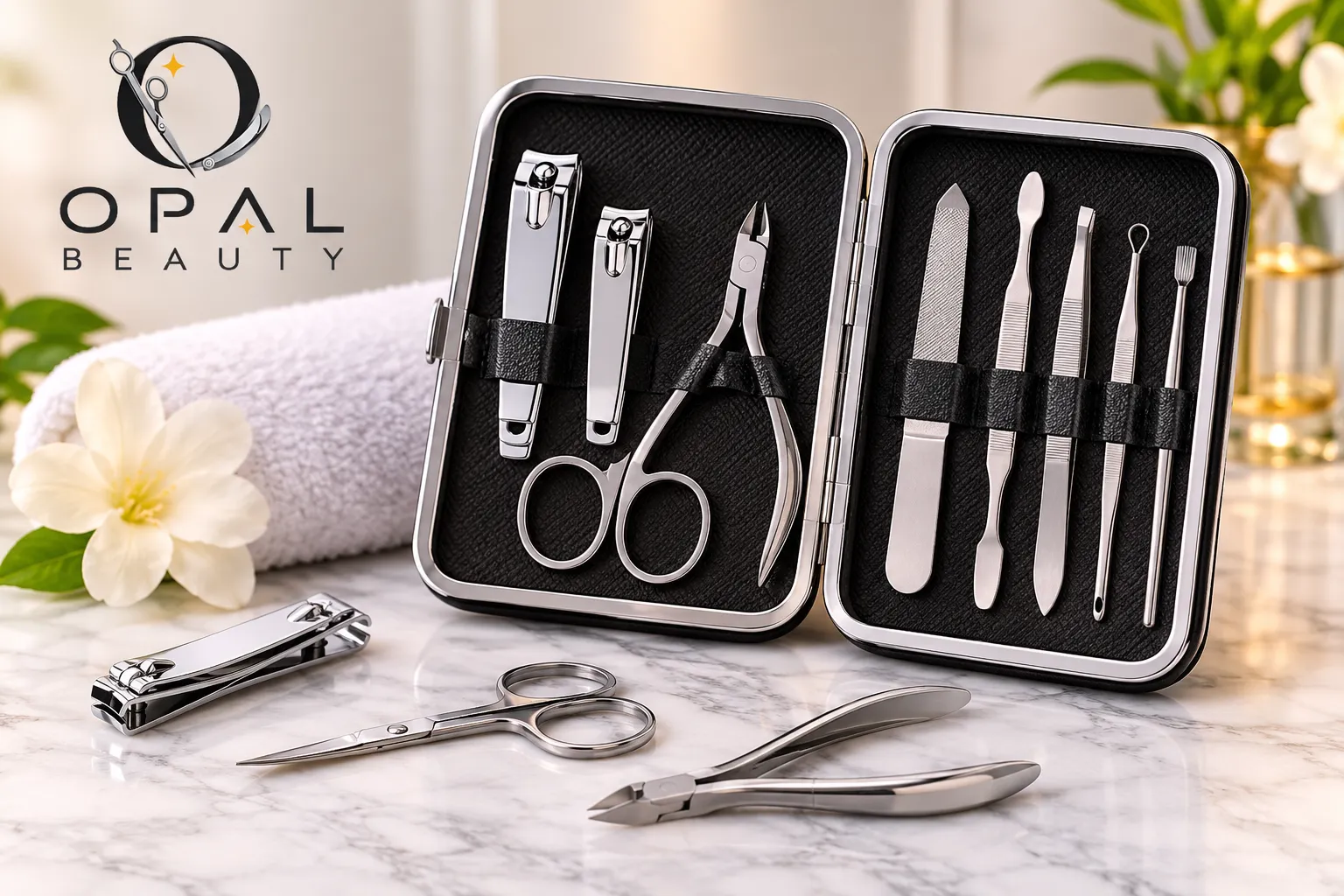
A typical professional set is built around a few cutting and shaping tools, with a few extras. The table shows common contents and how salon sets and retail kits usually differ.
| Tool | What it does | Salon set | Retail kit |
| Nail clipper | Shortens fingernails | Yes | Yes |
| Toenail clipper | Cuts thicker toenails | Often | Often |
| Nail scissors | Trims nails or fine detail | Yes | Yes |
| Cuticle nippers | Trims loose, dead skin and hangnails | Yes | Optional, with instructions |
| Cuticle pusher | Moves back softened cuticles | Yes | Yes |
| Nail file | Shapes and smooths the nail edge | Yes | Yes |
| Buffer | Smooths the nail surface | Yes | Optional |
| Tweezers | Lifts splinters and detail work | Often | Often |
| Nail cleaner | Clears debris from under the nail edge | Often | Yes |
| Nail brush | Sweeps away dust and debris | Often | Optional |
These are common patterns, not rules. Kit contents depend on the services offered and the customer.
Manicure Tools Names and Uses
Nail Clippers and Scissors
Clippers shorten the free edge quickly, and scissors give finer control for trimming or shaping. Fingernail clippers usually have smaller, curved or straight jaws, and toenail clippers have wider jaws and longer handles for thicker nails. Check that the jaws meet evenly, cut cleanly without crushing the nail, and return smoothly.
Cuticle Nippers
Nippers are small, spring-loaded cutters with fine jaws, used for loose, dead skin and hangnails, not for living skin. They need the closest attention to alignment, because jaws that do not meet cleanly tear instead of cut. Our guide to cuticle scissors vs nippers explains when each is used, and Opal Beauty’s cuticle cutters and nippers page lists its range.
Cuticle Pusher
A pusher gently moves back softened cuticles and can help clear the nail surface. Many are double-ended, with a rounded end and a flatter or scraping end. Check that working edges are smooth and rounded, with no burrs. Opal Beauty’s nail pushers page lists its range.
Nail File and Buffer
A file shapes and smooths the nail edge, and a buffer smooths the surface and adds shine. Files come in metal, glass or crystal, and paper-based forms, in different grits. Finer grits are generally used on natural nails, so ask the supplier for the grit and material, and do not assume one file suits all uses. Buffers are often foam or glass, and some forms are porous, which affects how they can be cleaned.
Tweezers
Tweezers lift splinters and loose skin and handle small items. Check that the tips align and the spring tension is even.
Nail Cleaner and Brush
A nail cleaner is a small scoop or hook used to clear debris from under the free edge, and a brush sweeps away dust. They are low-cost items, but their edges should be smooth, since they work close to the skin.
Cuticle Nipper and Pusher Set: Pairing the Tools
Many sets pair a cuticle nipper with a pusher, and buyers often search for the pair. The pusher softens and moves, and the nipper removes only what is loose and dead. When you list or specify the pair, match the finish and handle style so they look and feel like a set, and write each tool’s instructions separately, since they have different risks.
Professional Set vs. Retail Kit
What a Retail Kit Should Include
A kit sold to general consumers should be easy to use safely. A compact range usually works better than a long one: a fingernail clipper, a toenail clipper, scissors, a pusher, a file, tweezers, and a cleaner. Nippers can be included if they are clearly labeled for loose, dead skin, with instructions.
What to Leave Out
Some tools are better left out of kits for untrained users, because they increase the chance of misuse without adding much value. These include cuticle knives, sharp blades, forked or V-shaped cuticle trimmers, and heavy callus tools. Unrelated gadgets, such as ear picks or blackhead tools, can also make a nail kit feel unfocused and raise safety questions. Follow your market’s rules on what kits may contain and how they are labeled.
Piece Count vs. Quality
A high piece count looks attractive on a box but often means low-quality filler. A shorter kit of well-made tools usually earns better reviews and fewer returns.
Sample Kit Configurations
These are starting points for planning, not fixed standards.
- Compact retail kit (about 5 pieces): fingernail clipper, scissors, pusher, file, and tweezers, for everyday use and gifting.
- Standard retail kit (about 8 pieces): adds a toenail clipper, a nail cleaner, and optionally nippers with instructions.
- Salon set: the standard tools in a technician’s preferred styles, with spare clippers and nippers, and a plan for single-use items.
- Travel kit: a small selection in a slim case, with covers on every cutting edge.
Salon Sets and Backups
Salons often assign a set to each technician and keep spares of the tools that wear fastest, such as nippers and clippers, so work does not stop when a tool needs service. If you sell to salons, offer replacement tools by the piece, as well as complete sets.
Specifying Manicure Instruments
Material and Finish
Ask which steel is used and how the tools are finished, and whether they suit the cleaning method your customers use. Our guide to stainless steel nail instruments explains what to ask for.
Cutting Tools Need Their Own Checks
Cutting tools are where quality shows.
Alignment and Cutting
Jaws and blades should meet evenly and cut cleanly, without catching or crushing.
Spring and Joint
Springs should return smoothly, and joints should be firm, without wobble or grinding.
Test Several Units
Compare several samples of the same model with each other and with your approved reference, since consistency across units matters more than one good tool.
Care and Cleaning of Manicure Tools
Wipe and dry metal tools after use, store them in a case with protection for the cutting edges, and replace tools that are damaged or worn. Reusable metal implements and porous items, such as wooden sticks and some files and buffers, are treated differently in many professional settings, so check your local rules. Rules on cleaning and disinfection differ by region, so follow local regulations and the manufacturer’s instructions.
Packaging and Case
The case protects the tools and shapes the buyer’s first impression. Look for elastic loops or slots for each tool, covers for sharp edges, and a closure that keeps the contents secure. Add an instruction leaflet that explains each tool and its cautions, in the languages of your markets. Label kits clearly with contents and any markings your market requires.
Manicure Kits Across Markets
US salons are the main audience for professional sets, and the USA beauty instrument supplier page is a good place to start, with Canada alongside. Retail kits in the UK, Germany, France, and Italy may be smaller and more focused, with clear labeling and instructions in local languages. In Saudi Arabia and the UAE, gift-style kits with attractive cases may be popular. In Japan, South Korea, and China, buyers may look closely at finish and precision. These are general observations, not rules.
Sourcing Manicure Instruments From a Factory-Direct Manufacturer
Opal Beauty is a factory-direct manufacturer in Sialkot, Pakistan. Its manicure and pedicure kits page describes kits from a compact travel set to a larger salon set, with laser etching, case options, and retail-ready packaging, and it is the place to compare kit configurations. Our professional nail care tools wholesale guide covers the instruments in more depth, and the private label and custom branding service covers branding. Use our quality control checklist to plan sample approval.
What to Include in Your Quote Request
- The tools you want in the set, and quantity of each
- Whether the set is for salon use or retail
- Finish, branding method, and case style
- Instruction leaflet and packaging needs
- Destination country and delivery window
Request a quote with those details so each tool is specified separately.
Common Mistakes When Choosing a Manicure Kit
- Choosing by piece count: more pieces do not mean a better set.
- Including every tool in a retail kit: leave out tools that untrained users can misuse.
- Skipping alignment checks on nippers and clippers: poor jaws tear instead of cut.
- Ignoring file grit and material: the wrong file can damage natural nails.
- No instructions: buyers misuse tools they do not understand.
- Overlooking porous items: wooden sticks and some buffers cannot be cleaned like metal tools.
- No sample approval: quality shows only in the hand.
Frequently Asked Questions
What tools are in a manicure kit?
Usually clippers, scissors, a cuticle pusher, a file, tweezers, and a nail cleaner, and often nippers and a buffer. Professional sets may include more.
What is the difference between a professional set and a retail kit?
A professional set may include more instruments for trained users, while a retail kit usually keeps to fewer, safer tools with instructions.
Should a retail kit include cuticle nippers?
They can be included if clearly labeled for loose, dead skin, and if instructions are included. Some brands choose a pusher and file instead.
What is a cuticle nipper and pusher set?
A pairing of a pusher to move back softened cuticles and a nipper to remove loose, dead skin. Match their finish and write their instructions separately.
How many pieces should a manicure kit have?
There is no standard. Many retail kits work well with a handful of focused tools, and salon sets may include more.
Final Thoughts: Choose the Tools, Then the Count
Decide who the kit is for, then choose the tools that the user can handle well. Check alignment on the cutting tools, ask for the file grit and material, include instructions, and approve a sample before ordering. A shorter set of good tools beats a long set of filler.