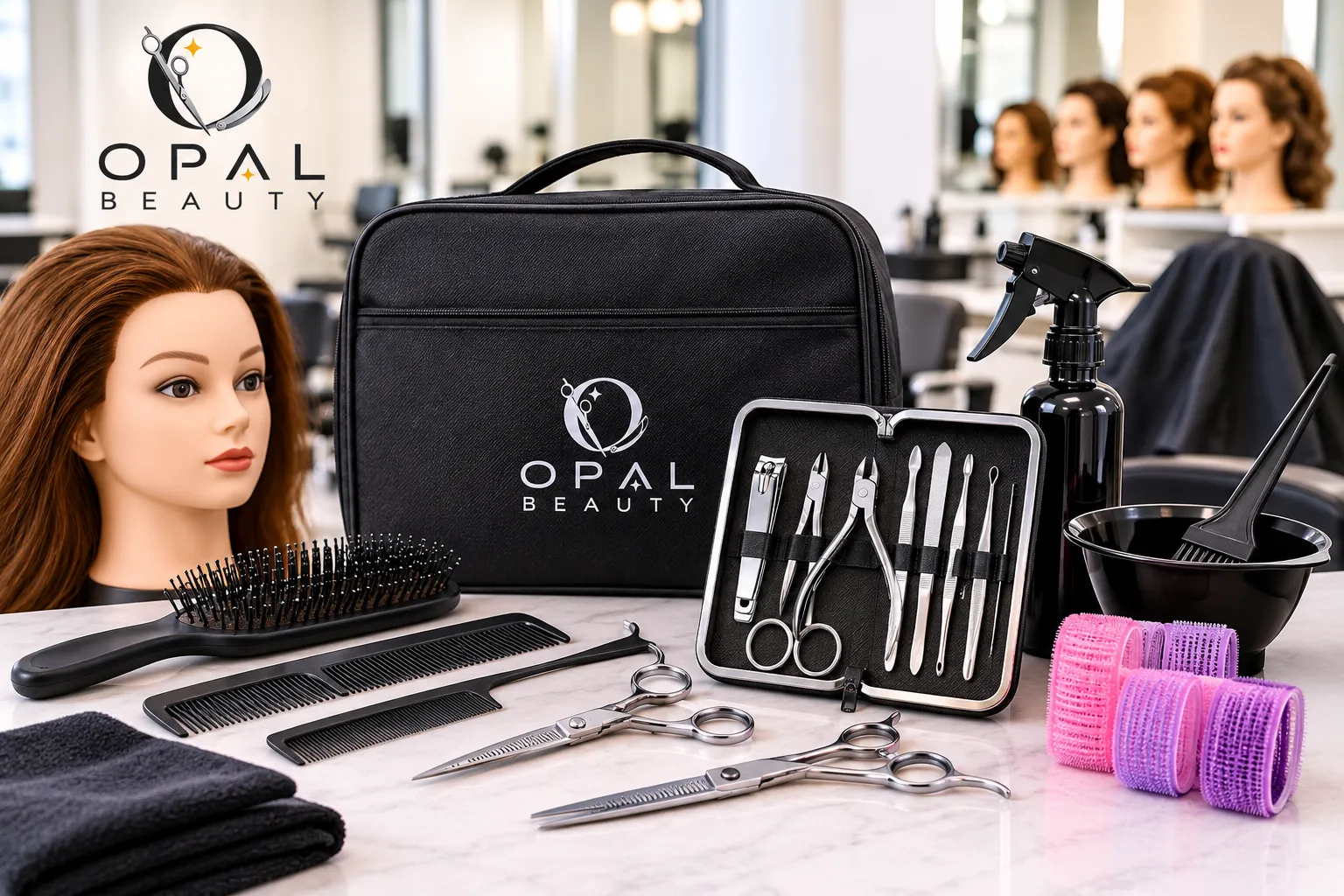

A cosmetology student kit is the first professional set of tools a student owns, and for a school it is a purchasing decision that repeats every intake. It has to cover the curriculum, match the board’s expectations, survive beginners, and arrive on time. This guide explains what a cosmetology student kit usually contains, which metal hand tools deserve the closest specification, how cosmetology, esthetician, and nail tech student kits differ, and how beauty schools source branded kits in bulk.
It is written for school owners, procurement managers, kit assemblers, distributors, and brands that sell to schools. It is general guidance, since requirements differ by region and curriculum. General industry guidance is kept separate from what Opal Beauty states on its site.
What a Cosmetology Student Kit Includes
Kit lists vary by school, curriculum, and licensing body, and your own list should come from your board and course plan. Most cosmetology kits are built from the same groups.
| Group | Typical items | Usually supplied by |
| Hair hand tools | Cutting shears, thinning shears, razor and blades, combs, brushes, clips | Tool manufacturers and distributors |
| Heat and electrical tools | Dryer, flat iron, curling or Marcel iron, clippers, trimmers | Electrical beauty-tool brands |
| Color and chemical tools | Bowls, brushes, bottles, foils, perm rods, gloves | Salon supply distributors |
| Practice items | Mannequin heads, stands, practice hands | Training suppliers |
| Nail and skin basics | Manicure implements, files, buffers, tweezers, brushes | Instrument manufacturers |
| Sanitation and storage | Gloves, disinfectant-compatible containers, cases, capes, aprons | Distributors and bag makers |
Opal Beauty makes metal hand tools. It does not list hot tools, mannequins, or consumables, so those come from other suppliers.
Hair Tools
Hair tools include shears for live work and for mannequins, thinning shears, a razor with replacement blades, cutting and sectioning combs, brushes, and clips. These are the tools students use most often, so they deserve a clear specification.
Heat and Electrical Tools
Dryers, irons, and clippers are usually branded electrical products, and they bring voltage, plug, and safety-certification requirements that vary by market. Treat them as a separate sourcing track from metal hand tools.
Color, Chemical, and Practice Items
Color bowls, brushes, bottles, foils, rods, and mannequins are consumable or semi-consumable. Many schools replace them each intake, so plan them separately from tools that students keep.
Nail and Skin Basics
Most cosmetology kits include a manicure implement set, files and buffers, tweezers, and a few skin and makeup basics. Our professional nail care tools wholesale guide explains the instruments in more detail.
Sanitation and Storage
Kits usually include gloves, containers for cleaning, a case or roll, a cape, and an apron. Rules on cleaning, disinfection, and which items are single-use differ by region, so follow your board’s requirements and the manufacturer’s instructions.
Metal Hand Tools: What Schools Should Specify
Shears and Thinning Shears
Students are beginners, so shears should be forgiving and consistent from pair to pair. Decide whether each student gets one pair or separate pairs for mannequin and live work, and whether thinning shears are in every kit. Offer left-handed options, and make sure a left-handed student does not receive a reversed-handle pair by mistake. Our professional hair cutting scissors buying guide covers length, edge, and handle choices, and Opal Beauty’s hairdressing scissors and razor and thinning shear sets pages list its ranges.
Tweezers
A pair of general-purpose tweezers is useful for makeup, brow, and nail work. Specify tip shape and alignment, and compare several units. Opal Beauty’s general-purpose beauty tweezers page lists its range.
Nail Implements
Manicure kits usually include nippers, a pusher, scissors, a clipper, and a file. Beginners can misuse sharp nippers, so schools often include clear instructions. Our guide to cuticle scissors vs nippers explains the difference, and Opal Beauty’s cuticle cutters and nippers and nail pushers pages list the products. For a full set, see its manicure and pedicure kits page.
Specifying Durable Tools
Student tools are used daily and cleaned often, so durability matters.
Build and Finish
Ask for smooth, burr-free edges, consistent alignment, and a finish that resists wear.
Corrosion Resistance and Cleaning
Ask which steel is used and how the tools are finished, and whether they are suited to the cleaning method your board requires. Our guide to stainless steel nail instruments covers what to ask.
Care Instructions in the Kit
Include a short card on cleaning, drying, storing, and sharpening, since students are new to caring for tools. Our scissor sharpening and care guide explains why shears should be sharpened by a specialist.
Cosmetology, Esthetician, and Nail Tech Student Kits
| Kit | Main focus | Typical items |
| Cosmetology starter kit | Hair, with nails and skin basics | Shears, combs, brushes, heat tools, color tools, mannequins, manicure implements |
| Esthetician student kit | Skin care, facials, waxing, makeup | Brushes, tweezers, spatulas, sponges, headbands, disposables, skin-care products |
| Nail tech student kit | Nail services | Nippers, pushers, files, buffers, brushes, practice hands, product supplies |
An esthetician kit usually leaves out hair tools, and larger equipment such as beds and steamers is typically owned by the school, not the student. A nail tech kit goes deeper on implements than a cosmetology kit. Check your board’s list for each program, and treat these as typical examples, not rules.
How Beauty Schools Source Student Kits in Bulk
Three Common Sourcing Models
| Model | How it works | Best for |
| Prebuilt kits | Buy a standard kit from an education supplier, and add school items | A fast start and predictable pricing |
| Custom-assembled kits | Give a supplier a bill of materials, and they source, pack, and ship | Matching a specific curriculum or board list |
| Private label | A manufacturer supplies tools with your logo, packaging, and inserts | Branding and differentiation |
Many schools combine the models: a kit assembler for the full set, with private-label tools, bags, and capes for the parts that carry the school’s name.
A Practical Bulk Process
- Write the specification: list every item, quantity, size, material, and brand preference.
- Request quotes: ask several suppliers for the same bill of materials at several quantities.
- Approve samples: examine real tools, not catalog images.
- Agree branding: approve logo method, placement, and packaging artwork.
- Inspect a production sample: agree on defect limits before shipment.
- Plan timing: confirm lead times and ship early enough for orientation.
What Schools Usually Brand
Schools most often brand low-risk items such as bags, capes, aprons, combs, brushes, cases, and packaging. Safety-critical items, such as electrical tools, are normally bought from established manufacturers, and cosmetics need extra regulatory care. Our guide to low MOQ private label beauty tools explains how smaller branded runs work.
Tiered Kits
Many schools offer more than one kit: a basic kit for students on shorter programs, a standard kit for full-time students, and a premium kit for academies that want a stronger brand presence. Keep the core hand tools consistent across tiers, so teaching stays the same, and vary the extras, such as cases, cosmetics, and add-on tools. That also makes reorders simpler, because each tier has a fixed bill of materials.
Questions to Ask About Price, MOQ, and Lead Time
Get an itemized quote with unit and kit cost, the MOQ per item and per kit, and what changes at higher volumes. Ask for lead times for first orders and reorders, replacement policy for defective items, and whether spare parts are available. Compare total cost per student, including freight and duties, not only the kit price.
Common Mistakes When Building Student Kits
- Using a generic list instead of your board’s: requirements differ.
- Choosing by the number of pieces: a large count of low-quality items serves students worse than a short list of good ones.
- Skipping samples: tools only show their quality in the hand.
- Forgetting left-handed students: they need true left-handed tools.
- Treating metal tools and electrical tools the same: they have different suppliers, standards, and lead times.
- No care card: beginners damage tools they do not know how to care for.
- Ordering too late: a late kit disrupts the first weeks of class.
Student Kits Across Markets
State and board requirements shape US kits, so US schools can start with the USA beauty instrument supplier page and Canada schools with theirs. Academies in the UK, Germany, France, and Italy may follow different qualification frameworks, so check each one’s kit expectations. In Saudi Arabia and the UAE, academies often brand their kits, and presentation may matter. Schools in Japan, South Korea, and China may look closely at tool precision. These are general observations, not rules.
Sourcing Metal Tools for Student Kits From Opal Beauty
Opal Beauty is a factory-direct manufacturer in Sialkot, Pakistan, with wholesale and bulk supply and private label and custom branding. Its site lists scissors, thinning shear and razor sets, tweezers, nail pushers, nippers, and manicure and pedicure kits, and describes laser etching and custom packaging. A school or kit assembler can use it for the metal tools and source dryers, mannequins, and consumables elsewhere. Ask which tools suit beginners, what documentation is available, and whether kit-specific cases and inserts can be made. Use our quality control checklist to plan sample approval.
What to Include in Your Quote Request
- The bill of materials for the metal tools, with quantities per kit
- Left-handed options and sizes you need
- Branding method, case or insert requirements, and care cards
- Kits per intake and how many intakes a year
- Destination country and the date kits must arrive
Request a quote with those details so each tool is specified separately.
Frequently Asked Questions
What is in a cosmetology student kit?
Usually hair tools, heat tools, color tools, mannequins, nail and skin basics, and sanitation and storage items. The exact list follows your board and curriculum.
What is the difference between a cosmetology kit and an esthetician kit?
A cosmetology kit centers on hair, while an esthetician kit centers on skin care, waxing, and makeup, with few or no hair tools.
How do beauty schools buy student kits in bulk?
By buying prebuilt kits, having a supplier assemble a custom kit, or private-labeling parts of the kit. Many schools combine these.
Can a school put its logo on student kit tools?
Often yes, through laser etching, printing on cases, or custom packaging. Ask the manufacturer about methods and minimums.
Does Opal Beauty supply complete cosmetology kits?
Its site lists metal hand tools and manicure kits, not hot tools, mannequins, or consumables. Ask in your quote how it can support your kit.
Final Thoughts: Build the Kit Around the Curriculum
Start from your board’s list and your course plan, then split the kit by supplier type. Specify the hand tools carefully, test samples, add a care card, and order early. A shorter kit of well-chosen tools serves students better than a long one that wears out in a term.