
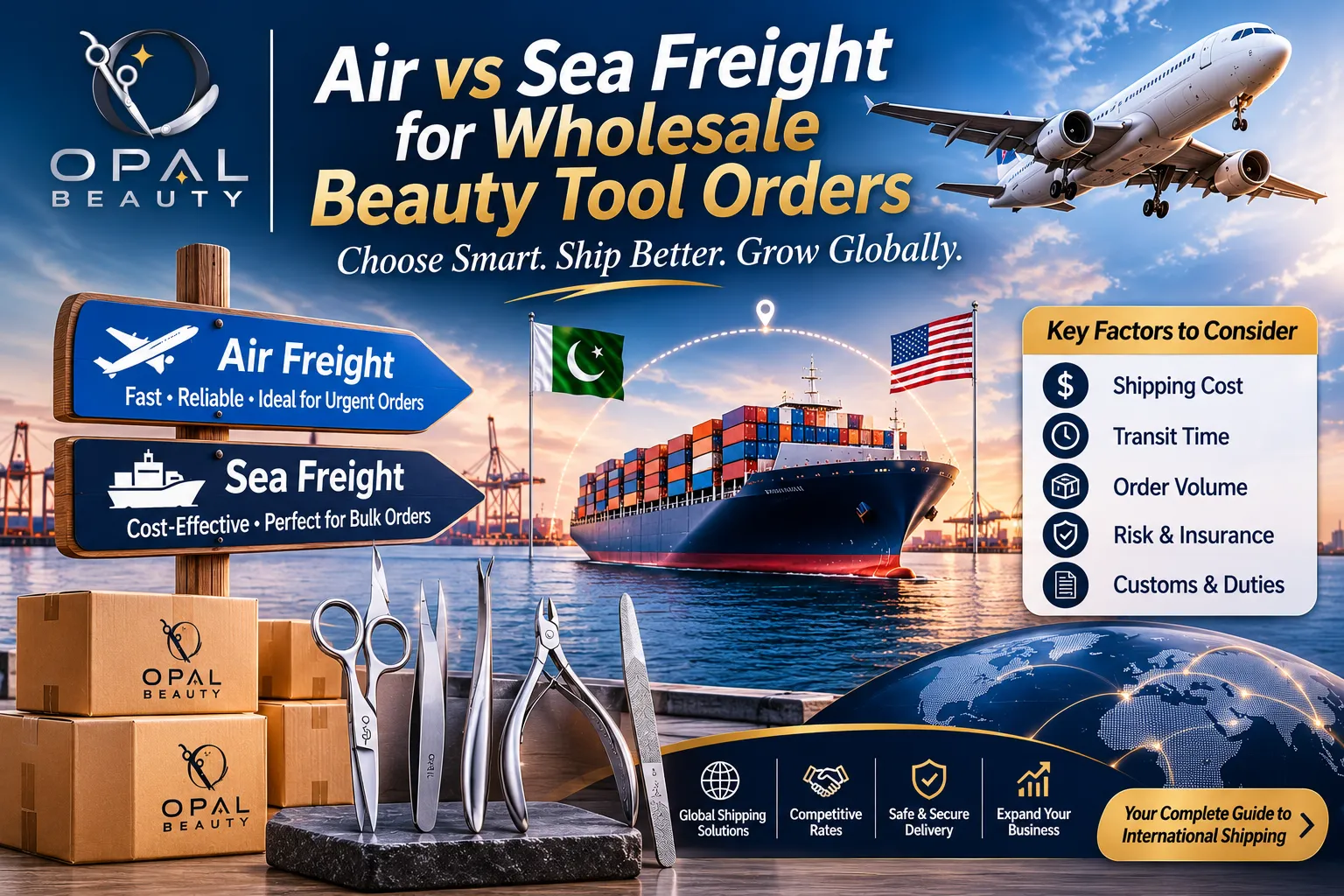

Air vs sea freight is the first shipping decision on a wholesale order of beauty tools, and the headline rule, “air is fast, sea is cheap,” is only a starting point. The right choice depends on order volume, how soon you need stock, what the quote includes, and how much delay you can absorb. This guide compares express courier, air cargo, LCL, and FCL for orders shipped from Pakistan, with a US buyer as the main example, and gives you a way to decide.
It is general information, not a freight quote. Transit times and prices vary by route, season, and carrier, so treat every range here as a planning figure and ask your forwarder for current numbers. General guidance is kept separate from what Opal Beauty states about its own process.
Air vs Sea Freight at a Glance
| Option | Best for | How it is priced | Speed | Watch-outs |
| Express courier | Samples, small urgent cartons | Per kg, door to door | Fastest, in days | Highest cost per kg |
| Air cargo | Urgent restocks, launches | Per chargeable kg | Days to about two weeks door to door | Bulky cartons raise the chargeable weight |
| Sea LCL | Small to medium regular orders | Per cubic meter, plus fixed charges | Several weeks | Extra handling and destination fees |
| Sea FCL | Large, predictable orders | Flat rate per container | Several weeks | Needs enough volume to be worthwhile |
Commonly quoted planning ranges are a few days for courier, days to about two weeks for air door to door, and roughly one to two months for sea, but they vary widely. Treat them as a starting point for questions, not as promises.
How Air and Courier Freight Are Priced
Chargeable Weight
Airlines and couriers charge on the greater of the actual weight and the volumetric weight. A common volumetric formula divides length × width × height in centimeters by 6,000. For example, a carton of 50 × 40 × 40 cm has a volume of 80,000 cm³, which gives a volumetric weight of about 13.3 kg. If the carton weighs 10 kg, you are charged for 13.3 kg. Carriers can use different divisors, so ask your forwarder which one applies.
Express Courier vs Air Cargo
Express courier moves cartons door to door and often includes clearance, which suits samples and small orders. Air cargo is usually airport to airport, so you or your forwarder arrange the pickup, customs brokerage, and final delivery. For small shipments, courier can be competitive once you add those extra steps. For heavier cartons, air cargo usually becomes cheaper per kg. Get both quotes with the same carton details.
How Sea Freight Is Priced: LCL and FCL
LCL Shipping
LCL shipping, or less-than-container load, shares a container with other importers. Rates are usually quoted per cubic meter, using a weight-or-measure rule where roughly one tonne counts the same as one cubic meter, and you pay on the larger figure. Your cartons are consolidated at the origin and unpacked at the destination, so the route adds handling charges, delivery-order fees, and sometimes storage. That extra handling also makes damage and delay more likely than with a sealed container.
LCL vs FCL: Where the Crossover Is
LCL vs FCL depends on volume, lane, and season. A common rule of thumb is that a full 20-foot container starts to compete once cargo reaches roughly 13 to 15 cubic meters, but it is only a rule of thumb. A 20-foot container holds roughly 28 to 33 cubic meters, depending on how it is measured, and the true crossover shifts with destination fees. FCL has its own clock: free days at the port, then demurrage and detention charges. When your cargo is near the crossover, request both quotes.
Compare the Whole Route
Compare the full cost from the factory to your warehouse, not the ocean rate alone.
Itemize Destination Charges
Ask for every line: origin pickup, export handling, ocean freight, terminal and handling charges, documentation, customs, and delivery.
Ask for the Validity Date
Freight rates change. Write down the date each quote expires, and the assumptions behind it.
Choosing by Order Size and Urgency
| Situation | Option to consider |
| Samples or a first small order | Express courier |
| Urgent restock or a fixed launch date | Air cargo |
| Regular replenishment with flexible timing | Sea LCL |
| Large, predictable orders | Sea FCL |
| Part urgent, part bulk | Split shipment |
A split shipment sends a small urgent quantity by air and the balance by sea. It can reduce launch risk, but it means two sets of documents and handling, and it makes landed cost harder to compare, so use it when early stock is clearly worth the premium. Some forwarders also offer sea-air routings through hub airports, so ask what is available on your lane.
Steel Hand Tools: Dense, but Bulky Once Boxed
A single tweezer or scissor is small and heavy for its size, but retail boxes, cases, pouches, and master cartons add volume. That matters because air is charged on chargeable weight and sea on volume. Ask your supplier for carton dimensions and gross weight, and check both numbers. For sea freight, ask about protective packaging against moisture, since steel tools can be affected by humidity and condensation on long routes. Ask your forwarder whether any items, such as razors, have carrier restrictions.
Customs Clearance Delay: What to Plan For
Mode does not change what customs wants, but delays hit modes differently. Common causes include vague product descriptions, mismatches between invoice and packing list, wrong tariff classification, missing documents, and random examinations. Air shipments usually clear faster when documents are clean, while LCL is more exposed because your cargo is released only after the consolidated container is unpacked.
For sea shipments to the US, ask your broker about the importer security filing deadline, and note that the air waybill and the ocean bill of lading are different transport documents. Our guide to importing beauty tools from Pakistan covers the documents. Build a buffer into your stock plan, and avoid promising delivery dates to your own customers until the route and documents are confirmed.
Freight Forwarder and Quotes: What to Send
A freight forwarder in Pakistan or one working for you at the destination can model the options, but the quote is only as good as the brief. Send:
- Destination country, city, and postal code
- Number of cartons, with dimensions and gross weight per carton
- Whether goods are ready or still in production
- Preferred mode and the latest acceptable arrival date
- Whether you want port or airport delivery, or door delivery
- The Incoterm you plan to use
Ask for two written scenarios, one air and one sea, with assumptions and validity dates.
Freight Cost per Kg Is Not the Whole Cost
Freight cost per kg is easy to compare, but it hides fixed charges, minimums, and destination fees. A low per-kg rate on a tiny shipment can cost more than a higher rate on a larger one. Compare total landed cost per unit instead, and use the same product and packing assumptions in each quote.
Duty, Valuation, and Shipping Mode
The shipping mode does not change the tariff rate. What changes is the cost base. In some markets, the customs value includes freight and insurance, and in others, such as the US, international freight is generally handled separately. Confirm how your market values the goods with a local broker.
Air vs Sea Freight Across Markets
The same logic applies everywhere, but routes and clearance differ. US buyers can start with the USA beauty instrument supplier page and Canada buyers with their page. Gulf destinations such as Saudi Arabia and the UAE are generally closer to Pakistan than North America, so transit is typically shorter, but confirm each lane. The UK, Germany, France, and Italy have their own customs timing and import tax rules. Japan, South Korea, and China buyers should check local clearance with a broker. Treat these as general observations, since requirements change over time.
Common Mistakes When Choosing a Shipping Mode
- Comparing headline rates only: destination fees, handling, and delivery can outweigh a low ocean rate.
- Choosing a mode before the carton data exists: dimensions and weights decide chargeable weight and cubic meters.
- Ignoring the delivery date: production finish is not arrival at your warehouse.
- Booking FCL without a plan for the port: free days run out quickly.
- Assuming LCL clears as fast as a sealed container: it waits on consolidation and unpacking.
- Letting the supplier choose the carrier without asking who it is: under some terms the seller books, so ask who the carrier or consolidator is.
Working With Opal Beauty on Shipping
Opal Beauty is a factory-direct manufacturer in Sialkot, Pakistan, with wholesale and bulk supply. Its site says it provides the documentation needed for international shipping, works with established logistics providers, and inspects bulk shipments before departure. Ask the team for carton dimensions, gross weight, and cartons per order, so your forwarder can quote accurately. Our production timeline guide helps you work back from your launch date, and our guides to low-MOQ private label and dropshipping vs wholesale help you plan order size.
What to Include in Your Quote Request
- Products, quantities, and packaging
- Destination country and required arrival date
- Preferred shipping mode, or a request to compare two
- The Incoterm you plan to use
- Whether you need carton dimensions and weights for your forwarder
Request a quote with those details so production and shipping plans are made together.
Frequently Asked Questions
Is air or sea freight cheaper for a small wholesale order?
Often it depends on volume. For very small orders, courier or air can be competitive because LCL adds fixed handling charges. For larger, flexible orders, sea is usually cheaper. Compare itemized quotes for both.
When does FCL make sense?
When your cargo is near or above the point where a full container costs less than LCL. A common rule of thumb is around 13 to 15 cubic meters, but quote both.
How long does shipping take?
Courier is the fastest, air takes days to a couple of weeks, and sea takes weeks. Ask your forwarder for current figures on your lane, and add a buffer for clearance.
Can I split a shipment between air and sea?
Yes, many buyers send urgent stock by air and the balance by sea. It adds paperwork and cost, so use it when the early stock is clearly worth it.
Does shipping mode change import duty?
It does not change the tariff rate, but it can change the cost base in markets that include freight in customs value. Confirm with a broker.
Final Thoughts: Choose the Mode That Fits the Order
Start from the date you need stock, the volume you have, and the delay you can absorb. Then compare itemized quotes for two options on the same assumptions. A shipping plan built that way holds up better than a rule of thumb.