
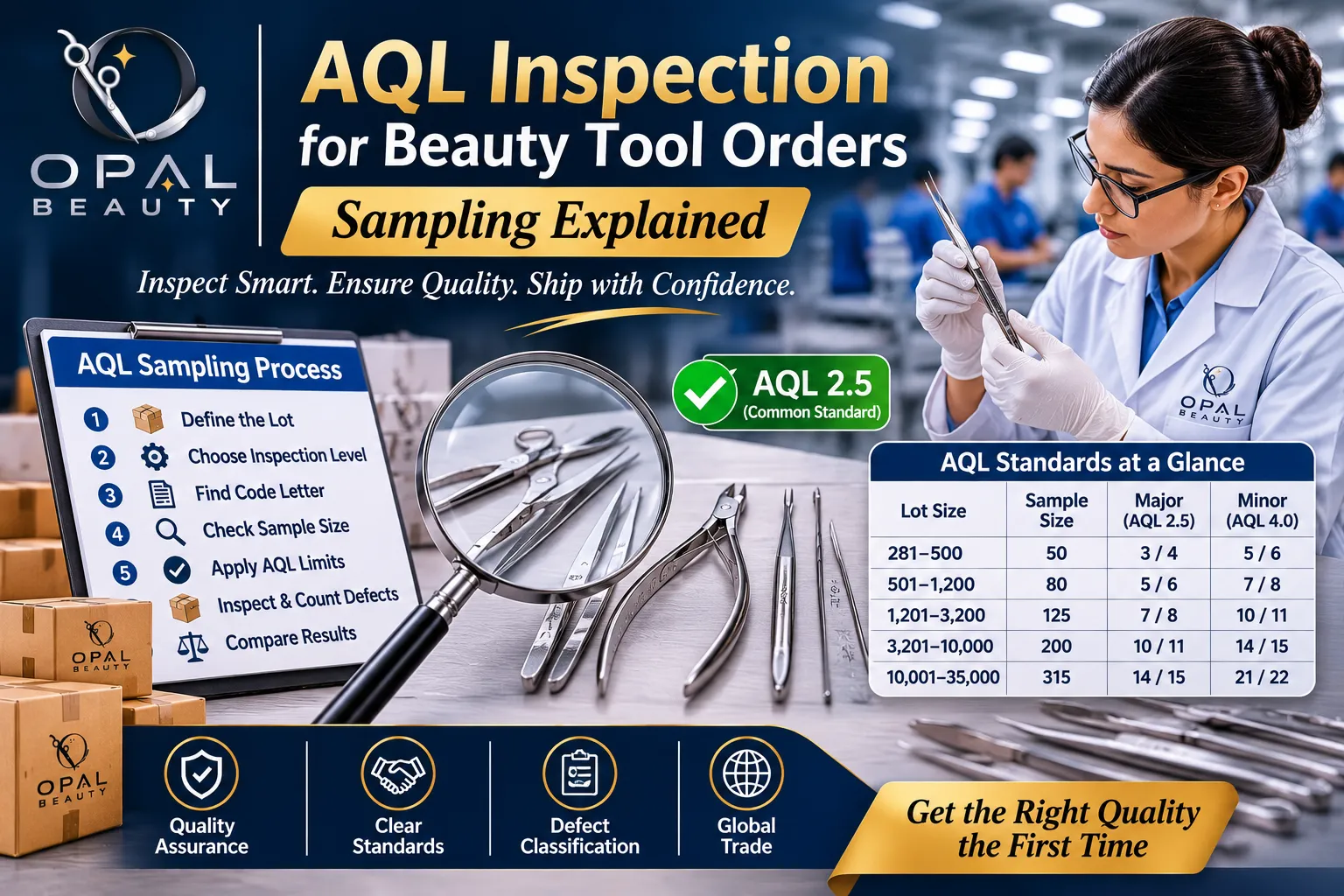

You cannot check every tweezer, nipper, and scissor in a 3,000-piece order, so most buyers inspect a sample and decide on the whole lot from it. That is what AQL sampling does. It is also easy to misread, which is why a clean-looking inspection report can still leave an argument about what “pass” meant. This guide explains how AQL inspection works, shows sample sizes and accept and reject numbers for common order sizes, classifies defects for beauty tools, and covers how to read an inspection report and write the rules into a purchase order.
It covers the sampling method and leaves the item-by-item checks to our quality control checklist. It is general information for importers, QA managers, and brand buyers, and not a substitute for an inspector or lawyer. General guidance is kept separate from what Opal Beauty states about its own process.
What AQL Inspection Is and Is Not
AQL stands for Acceptance Quality Limit, formerly Acceptable Quality Level. It is part of a sampling standard, ISO 2859-1, and its US counterpart ANSI/ASQ Z1.4. The method tells you how many units to inspect from a lot, and how many defects you can find before you reject it.
AQL is not a zero-defect guarantee, and it does not mean that 2.5% of your order is allowed to be defective. It is a statistical decision rule: the plan is designed so that lots at or better than the agreed quality are usually accepted, and poorer lots are usually rejected. A passing result means the sample stayed within the agreed limits, not that every unit is perfect.
AQL 2.5 Explained
AQL 2.5 is the figure most commonly used for major defects on general consumer goods, often paired with AQL 4.0 for minor defects and zero acceptance for critical defects. It is a common starting point, not a rule. A premium product, a safety-sensitive item, or a first order with a new supplier may justify stricter limits. Name the figures you want in your purchase order.
How AQL Sampling Works Step by Step
- Define the lot: the total quantity, by SKU, size, finish, and carton, that is ready for inspection.
- Choose the inspection level: General Level II is the usual default for consumer goods.
- Find the code letter: the lot size and inspection level point to a letter in the standard’s first table.
- Read the sample size: the code letter gives the number of units to inspect.
- Pick the AQL for each defect class: for example critical, major, and minor.
- Draw a random sample: spread across cartons, not just the top layer.
- Count defects by class: record them separately.
- Compare with the accept and reject numbers: if the count reaches the reject number, that class fails.
Inspection Levels vs. Severity
Two things are often confused. The general inspection levels, I, II, and III, set how large the sample is relative to the lot, with level III the largest. Normal, tightened, and reduced inspection describe severity, and the standard has switching rules that move you between them depending on recent results. After repeated failures, a buyer moves to tightened inspection, and after a long run of clean lots, some buyers use reduced inspection.
AQL Chart: Sample Sizes for Common Lot Sizes
The table shows values for General Inspection Level II, normal inspection, and single sampling, taken from the standard’s tables. Confirm them against your edition of the standard or your inspector’s calculator before you use them in a contract.
| Lot size | Code letter | Sample size | Major, AQL 2.5 (accept / reject) | Minor, AQL 4.0 (accept / reject) |
| 281–500 | H | 50 | 3 / 4 | 5 / 6 |
| 501–1,200 | J | 80 | 5 / 6 | 7 / 8 |
| 1,201–3,200 | K | 125 | 7 / 8 | 10 / 11 |
| 3,201–10,000 | L | 200 | 10 / 11 | 14 / 15 |
| 10,001–35,000 | M | 315 | 14 / 15 | 21 / 22 |
Critical defects are usually set at zero acceptance, so one critical defect in the sample fails the lot.
Worked Example: A 3,000-Unit Lot
A lot of 3,000 units falls in the 1,201 to 3,200 range, so the code letter is K and the sample is 125 units. Major defects pass at 7 or fewer and fail at 8 or more. Minor defects pass at 10 or fewer and fail at 11 or more. Critical defects pass only at zero. Each class is judged separately, so you do not add major and minor defects together.
If the 3,000 units are three different models, treat each model as its own lot. Otherwise a good batch of one product can hide a poor batch of another.
Defect Classes for Beauty Tools
The class of a defect decides which limit applies, so agree the classes before the inspection starts.
| Class | Meaning | Examples for tweezers and scissors |
| Critical | Safety or legal problem; zero acceptance | Hazardous burrs or sharp points in the wrong place, cracked or broken parts, contamination |
| Major | Affects function or saleability | Tips that do not meet, blades that do not align or cut, loose or jammed pivot, rust or pitting, wrong model, size, or logo |
| Minor | Small cosmetic issue | Light scratches, minor finish variation, small packaging print flaws |
These are examples, not a standard. A scratch that is minor on a basic tool may be major on a premium retail product, and a defect that makes a cutting tool unsafe should not be downgraded to minor. Missing legal markings are treated as critical by some buyers, so decide how you classify them.
Agree Defect Examples Before Inspection
Do not debate severity after the report arrives. Put photos of acceptable and unacceptable examples in your inspection brief, so the buyer, supplier, and inspector use the same definitions.
Counting Rules
Decide how defects are counted before the inspector starts.
Defective Units vs. Defects
A single unit can have several small flaws. State whether you count defective units or individual defects, and whether a unit with one major and one minor defect counts in both classes.
Write the Rule in the Purchase Order
Put the counting rule, the defect classes, and the AQL figures in the PO, so the factory has agreed to them in advance.
Reading an Inspection Report
A useful inspection report lets you make a release decision without a phone call. It should include:
- The lot map: quantity by SKU, carton count, and what was ready
- The standard, edition, inspection level, and AQL for each class
- The sample size, and how and where samples were drawn
- Defect counts by class, with photos
- The accept and reject numbers, and the result for each class
- Carton and packing checks, with photos
- A clear recommendation: release, hold, sort, rework, or reinspect
Check the lot map first, because a result that covers only part of the order is not a result for the whole order. A pass does not replace testing against your specification, and it does not prove every unit is free of defects.
What to Do When a Lot Fails
A failed lot does not always mean rejection. Options include sorting affected units, supplier rework, relabeling or repacking, extra checks, or reinspection after correction. Decide in advance who pays for correction and reinspection, and what evidence proves the fix.
When to Inspect: Pre-Shipment and During Production
Pre-shipment inspection is usually done once all of the order is produced and at least 80% is packed, so the sample can be drawn at random from finished cartons. During-production inspection catches problems earlier, and is worth considering for first orders or complex finishes. Approve a golden sample first, so the inspector has a benchmark. Our production timeline guide helps you build inspection dates into your schedule, and our quality control checklist covers what to check on the goods.
Writing AQL Into Your Purchase Order
Keep the wording short and specific:
- Standard and edition, such as ISO 2859-1 or ANSI/ASQ Z1.4
- Inspection level, severity, and single sampling
- AQL for critical, major, and minor defects
- Lot definition, including one lot per model
- Defect definitions, with photo examples
- Counting rule
- Action on failure, and who pays for correction and reinspection
- Shipment release only after the buyer approves the inspection report
Common AQL Mistakes
- Starting from the sample size: define the lot and the defect classes first.
- Combining models in one lot: it lets a good model mask a bad one.
- Sampling from convenient cartons: a correct sample size from the wrong cartons is weak evidence.
- Treating AQL as a guarantee: it is a sampling decision, not a promise.
- Reading AQL 2.5 as a 2.5% allowance: it is a plan parameter.
- No action rule: a failed report with no agreed next step becomes an argument.
- Copying old tables: check the edition and the figures against the standard.
AQL Across Markets
AQL plans are used worldwide. US buyers often refer to ANSI/ASQ Z1.4 and can start with the USA beauty instrument supplier page, while buyers in the UK, Germany, France, and Italy often reference ISO 2859. Buyers in Canada, Japan, South Korea, China, Saudi Arabia, and the UAE may have their own inspection requirements or preferred agencies, so confirm them with local partners. These are general observations, not rules.
Working With Opal Beauty on Inspection
Opal Beauty is a factory-direct manufacturer in Sialkot, Pakistan, with wholesale and bulk supply. Its site says every bulk shipment goes through final inspection before departure, and its quality and manufacturing standards page describes testing during production. It does not state which sampling standard or AQL it uses, or whether buyers may use third-party inspectors. Ask the team, and agree on the plan before production. Our guide to common private label mistakes covers errors to avoid, and the private label and custom branding service covers the overall process.
What to Include in Your Quote Request
- Products, models, and quantities per model
- Your preferred standard, inspection level, and AQL figures
- Whether you will use a third-party inspector
- The inspection report format you need
- Timing, so inspection fits your shipping plan
Request a quote with those details so inspection terms are agreed with the order.
Frequently Asked Questions
What does AQL 2.5 mean?
It is the acceptance quality limit commonly used for major defects. It sets the accept and reject numbers for a given sample size. It does not mean 2.5% of the order may be defective.
Does a passed AQL inspection mean there are no defects?
No. It means the sample stayed within the agreed limits. Some defective units can remain in a passing lot.
What is the sample size for 3,000 units?
At General Level II, normal inspection, it is 125 units, with 7 and 8 as the accept and reject numbers for major defects at AQL 2.5.
Should different models be inspected as separate lots?
Usually yes. It prevents one good model from hiding a poor one.
When should the inspection happen?
Usually when all of the order is produced and at least 80% is packed, with an optional earlier inspection during production.
Final Thoughts: Agree the Rules Before the Inspection
Define the lot, the defect classes, the AQL figures, and the action on failure in your purchase order, and ask for a clear inspection report. A plan agreed in advance turns a pass or fail into a decision, not a dispute.