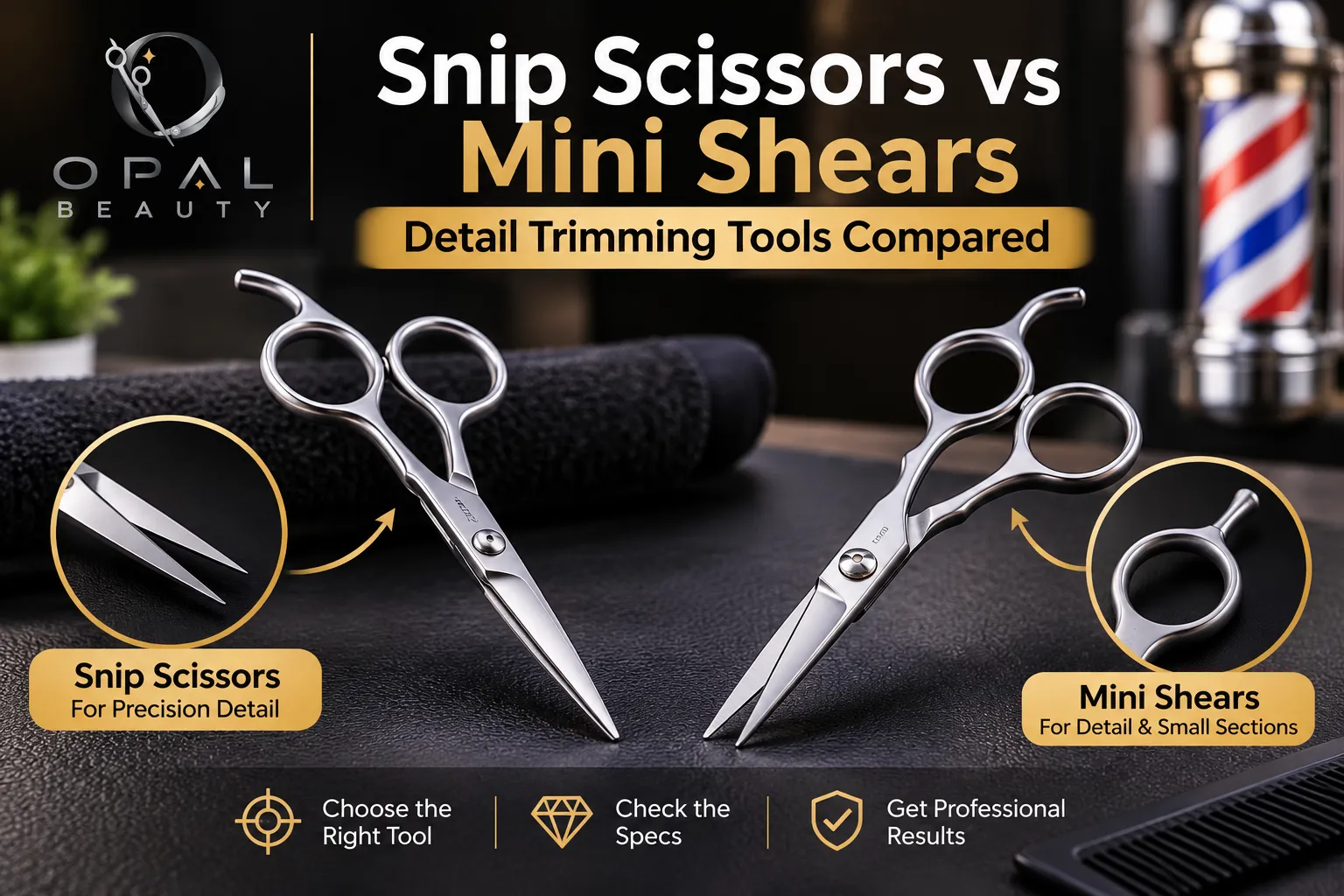

Search for “snip scissors” and most results show sewing thread snips, garden snips, or metal-cutting tin snips. This guide is about something else: small hair-cutting scissors used for detail trimming in barbershops and salons. It compares snip scissors vs mini shears, explains which cut each suits, and shows buyers how to name, specify, and sample detail scissors so that what arrives is a hair tool, not a craft scissor.
It is written for barbers, salon owners, distributors, and brands that sell to them. General industry guidance is kept separate from what Opal Beauty states on its site.
What “Snip Scissors” and “Mini Shears” Mean in Hair Cutting
Not Sewing or Metal Snips
In sewing, snips are spring-loaded thread cutters. In metalwork, snips cut sheet metal. In hair, snip scissors are small precision scissors for fine work. They share a name and little else, so product titles and search terms need the word “hair” or “barber” to avoid confusion.
Snip Scissors
Hair snips, or snip scissors, are short, fine-tipped scissors used for detail work: stray hairs, mustache and beard edges, around the ears, and fine finishing. Their short blades give close control, but they are slower for cutting larger sections.
Mini Shears
Mini shears, sometimes called mini hair scissors, are scaled-down professional hair-cutting shears. They tend to keep features of full-size shears, such as adjustable tension and ergonomic handles, in a smaller size, so they can handle detail work and small sections.
Why the Terms Overlap
The two names are not standardized. Sellers also use detail scissors, detail shears, small hair scissors, small hair trimming scissors, and trimming scissors for similar tools. Some use “snip” and “mini shear” for the same product. Do not rely on the name alone. Compare blade length, tip shape, handle, and tension. A useful test is to ask what the tool is meant to cut and how much of the hand it needs: a pair built for single strays and a pair built for small sections may both be sold as “snips,” and they behave very differently in a working barber’s hand.
Snip Scissors vs Mini Shears: Side-by-Side
| Feature | Snip scissors | Mini shears |
| Main job | Precision detail and strays | Detail work plus small sections |
| Blade length | Short | Short to mid-short |
| Tips | Often fine and pointed | Pointed or rounded |
| Handle | Often compact, sometimes symmetrical rings | Often shear-style with ergonomic features |
| Tension | May be simpler | Usually adjustable |
| Limits | Slow for sections | Still small for large sections |
Published sizes vary. Sources describe snips and mini shears anywhere from roughly 3.5 to 5.5 inches, so specify blade length in millimeters, with inches in brackets for US buyers, and use a sample as the reference. The table shows typical differences, not standards.
Which Tool for Which Detail Cut
Beard and Mustache
Snip scissors suit stray hairs and tiny corrections around the mustache and beard edge. For shaping beard length or working larger sections, mini shears or full-size trimming shears are more comfortable. Our guide to barber scissors vs regular scissors explains what separates professional hair scissors from general scissors.
Neckline
A trimmer usually sets the baseline of a neckline, and scissors then refine the outline and remove strays. Scissors should not be used to scrape against the skin. For very close finishing, use a trimmer or razor as local rules and training allow.
Ears, Fringe, and Fine Detail
Around the ears and fringe, short blades keep the tips under control. Many barbers also use small scissors for softening the ends of a cut. Our guides to scissor-over-comb cutting and types of hair scissors cover the techniques where full-size shears lead, and where small scissors help.
Working Near the Skin
Detail work puts the tips close to the skin, around the ears, nose, and lip line. Use controlled, short cuts, keep the tips away from the skin as you work, and consider rounded-tip designs for facial hair if your barbers prefer them. Training and local rules decide what services a technician may perform, so follow them, and avoid making safety claims about a tool in your own marketing.
What to Check When Buying Detail Scissors
Blade Length, Tip Shape, and Finger-Ring Fit
Blade Length
Write the blade length and overall length in millimeters. A short blade gives control, and too short a blade makes even small sections slow.
Tip Shape
Pointed tips pick up individual hairs. Rounded tips are gentler near the skin and are sometimes preferred for facial hair. Choose by the job, and offer both if your customers split.
Test the Finger Rings
Small handles do not fit every hand. Have several barbers try samples through a working session, and note which ring size and shape feel comfortable.
Edge, Tension, and Pivot
A fine tip is only useful if the blades meet cleanly all the way to the point. Check that the tension screw adjusts smoothly, that the blades close without catching, and that several units of the same model feel alike.
Steel and Finish
“Stainless steel” says little. Ask which steel is used and how the scissor is finished. Be cautious with claims that cannot be documented.
How to Test a Sample Pair
Ask for samples of the exact model you plan to stock, then check:
- Tip closure: close the scissors slowly under good light. The tips should meet cleanly with no gap or crossing.
- Cutting action: try the scissors on hair, and see whether they cut the whole length of the blade without folding or pushing the hair.
- Tension: adjust the screw and confirm the movement stays smooth, with no grinding.
- Comfort: have a barber use the pair through a working session.
- Finish: look for burrs, rough edges, and uneven finish.
- Consistency: compare several units with each other and with your reference.
Naming and Listing Detail Scissors Clearly
For distributors and brands, vague names cause returns. Name each product by what it is, for example “hair snip scissors, 4 in (102 mm), pointed tips” or “mini hair shears, 5 in (127 mm), offset handle.” These are formatting examples, not Opal Beauty specifications. Add a close-up photo of the tips and the handle, and state whether the product is for hair or for general grooming.
When you source from a supplier, ask specifically for professional hair-cutting detail scissors, not manicure, embroidery, or general-purpose scissors. Request a sample before a bulk order, and keep it as your reference.
Common Mistakes When Buying Detail Scissors
- Choosing by name alone: “snip,” “mini,” and “detail” mean different things to different sellers.
- Buying craft or embroidery scissors by accident: ask for hair-cutting detail scissors.
- Ignoring finger-ring fit: small handles do not fit every hand.
- Expecting one small pair to replace full-size shears: it slows larger work.
- Skipping samples: tip alignment and tension only show in the hand.
- Forgetting care: small tips need protection and sharpening by a specialist.
Range Planning for Shops and Brands
These are starting points, not rules.
- Barber: a cutting shear for daily work, plus one pair of detail scissors for strays and edges.
- Salon: detail scissors for fringe and fine finishing, alongside full-size shears.
- Distributor: both snip and mini shear styles, with clear names so buyers know the difference.
- Brand: one hero detail scissor first, then add a second tip shape or size once it sells.
Detail scissors also work well as add-ons, since they are small, giftable, and easy to merchandise. Our barber tools list explains where they fit in a shop’s full set of hand tools.
Care and Handling of Small Scissors
Small tips are easy to damage, so store detail scissors in a sleeve or case and avoid dropping them. Wipe hair from the blades after use and dry them. Professional scissors should be sharpened by a specialist or the manufacturer. Our scissor sharpening and care guide explains why. Rules for cleaning and disinfection differ by region, so follow local regulations and the manufacturer’s instructions.
Detail Scissors Across Markets
US barbers are the main audience for this guide, and the USA beauty instrument supplier page is the place to start. Fine detail work may be especially valued in Japan and South Korea, where buyers may look closely at tip precision. Buyers in Canada, the UK, Germany, France, and Italy may use different names for the same tools, so match titles to local search terms. In China, Saudi Arabia, and the UAE, grooming is a strong part of the professional scene, and presentation may matter. These are general observations, not rules.
Sourcing Detail Scissors From a Factory-Direct Manufacturer
Opal Beauty is a factory-direct manufacturer in Sialkot, Pakistan. Its precision snip scissors page describes short snip scissors with tapered tips and adjustable tension, along with laser etching, packaging options, and several finishes. It does not list mini shears as a separate product, so ask which sizes and styles are available. For full-size cutting shears, see its hairdressing scissors page, and for branding see its private label and custom branding service. Use our quality control checklist to plan sample approval.
What to Include in Your Quote Request
- Product type: snip scissors, mini shears, or both
- Blade length and overall length in millimeters, tip shape, and handle style
- Finish, branding files, and packaging format
- Quantity per model, destination country, and delivery window
Request a quote with those details so each model is specified separately.
Frequently Asked Questions
What are snip scissors used for in hairdressing?
They are used for fine detail work such as stray hairs, mustache and beard edges, around the ears, and finishing touches.
Are snip scissors and mini shears the same?
Not always. The terms are not standardized, and sellers use them differently. Compare blade length, tips, handle, and tension.
What size should detail scissors be?
There is no standard. Published sizes range from roughly 3.5 to 5.5 inches, so choose by the job and the hand, and specify the size in millimeters.
Can snip scissors replace full-size shears?
Usually not. Snips are slow for larger sections, so most barbers use them alongside full-size shears.
Does Opal Beauty make mini shears?
Its site lists snip scissors, not mini shears. Ask in your quote about available sizes and styles.
Final Thoughts: Compare the Specs, Not the Name
Snip scissors and mini shears overlap, so judge detail scissors by blade length, tip shape, handle, and tension. Name each product clearly, test samples with working barbers, and pair detail scissors with a full-size shear. A clear spec prevents most disappointments.