
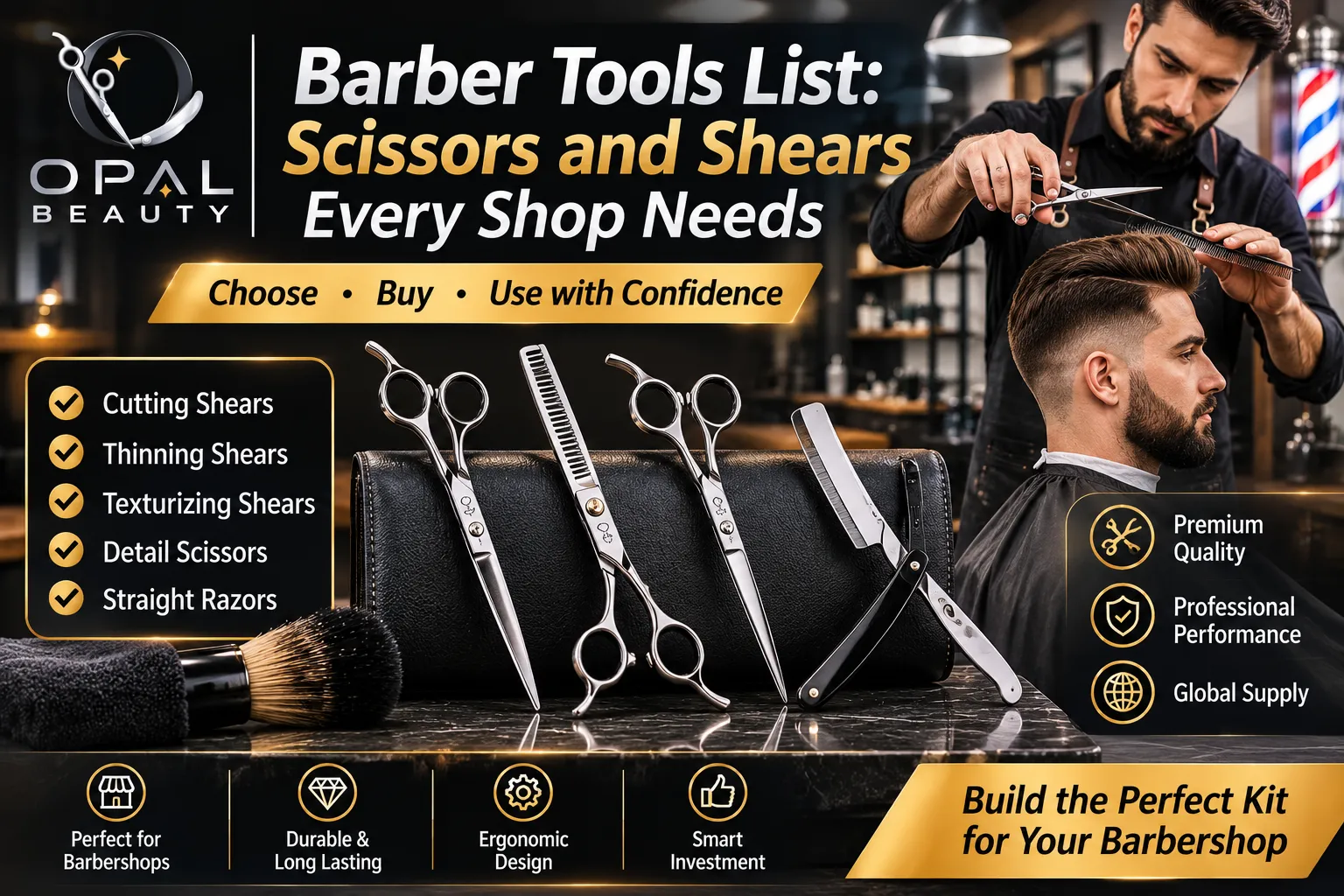

Opening a barbershop, or restocking an existing one, starts with one practical question: what do we buy first? Clippers and chairs usually get the attention, but the hand tools, the shears, thinning shears, detail scissors, and razors, decide how precisely a barber can finish a cut. This barber tools list covers the cutting hand tools every shop needs, what to buy first, what can wait, and how to specify them if you buy for a shop, a chain, or a brand.
It is written for new barbershop owners, barber supply buyers, and brands that sell to barbers. The list is general guidance, since services, staffing, and local rules differ. General industry guidance is kept separate from what Opal Beauty states on its site.
Barber Tools at a Glance: What a Shop Needs
A complete shop needs several tool groups. This guide covers the first row in depth and names the rest so nothing is missed.
| Group | Examples | Covered here? |
| Cutting hand tools | Cutting shears, thinning shears, texturizing shears, snip scissors, straight razors | Yes |
| Electric tools | Clippers, trimmers, foil shavers | Named only |
| Combs and brushes | Cutting combs, taper combs, fade and neck brushes | Named only |
| Client supplies | Capes, neck strips, towels | Named only |
| Sanitation | Disinfectants, jars, clipper oil, sharps containers | Named only |
| Station and furniture | Chairs, mirrors, trolleys, lighting | Named only |
Opal Beauty makes cutting hand tools. It does not list clippers, chairs, capes, or sanitation products, so buy those from specialist suppliers. Check your state or local board for any required tools or equipment lists.
Clippers, trimmers, and foil shavers handle bulk work and edging, and combs and brushes support them. Client supplies, sanitation products, and furniture complete the station. None of these is a substitute for good cutting hand tools, and none comes from the same supplier as shears. Plan the budget by group, so a shop does not spend all of it on chairs and have nothing left for the tools used on every cut.
Barber Shop Tools: The Cutting Hand Tools Every Shop Needs
Cutting Shears
A cutting shear is the daily workhorse for sectioning, blunt cuts, point cutting, and scissor-over-comb work. Many barbers start with a blade in the 5.5 to 6.5 inch range, and some choose a longer blade for scissor-over-comb work. Sources differ on the ideal length, so treat these numbers as starting points and let hand size and technique decide. Our guides to scissor-over-comb cutting and types of hair scissors explain how length, edge, and handle affect the work, and Opal Beauty’s hairdressing scissors page lists its cutting range.
Thinning and Blending Shears
Thinning shears remove weight and soften transitions, such as where a clipper fade meets scissor work. Tooth count changes how much hair each stroke removes, and published advice on tooth counts varies, so confirm what suits your services with your barbers. Our guide to thinning vs texturizing scissors explains the difference, and Opal Beauty’s razor and thinning shear sets page lists its sets.
Texturizing and Chunking Shears
Texturizing shears create deliberate texture and usually have fewer, wider-spaced teeth. They are an optional second purchase. Add them when clients regularly ask for textured styles, not before.
Detail and Snip Scissors
Short detail scissors, often called snips, give control around the ears, neckline, fringe, and mustache. They are a useful addition once a barber regularly does scissor detail work. Opal Beauty’s precision snip scissors page lists its range.
Straight Razors and Shavettes
Shops that offer shaves or crisp neckline work need a straight razor or a razor that takes replaceable blades. Rules on blade use, disposal, and sharps containers differ by region, so follow local regulations and the manufacturer’s instructions. Our guide to razor vs scissors explains when stylists use each.
Which Tool for Which Job
Matching the tool to the job keeps technicians from stretching one pair across everything. The table gives common starting points, not rules.
| Job | Tool commonly used |
| Sectioning, blunt cuts, perimeter work | Cutting shear |
| Scissor-over-comb | Longer cutting shear |
| Point cutting and softening ends | Cutting shear with fine tips |
| Blending clipper work into scissor work | Blending shear |
| Adding visible texture | Texturizing shear |
| Ears, neckline, fringe, mustache detail | Detail or snip scissors |
| Clean necklines and shaves | Straight razor, where offered |
A technician may use more than one tool in a single cut. That is why a small, well-matched set serves better than one pair asked to do everything.
What to Buy First and What Can Wait
| Priority | Items | Why |
| Buy first | One cutting shear and one blending shear per barber | They cover most daily work |
| Buy first, if offered | A razor for shave and neckline services | Needed only if the service menu includes it |
| Add next | Detail or snip scissors | Useful once scissor detail work is regular |
| Add later | Texturizing shears, a second cutting shear | Added when demand or rotation justifies it |
| Specialty | Ergonomic or left-handed designs | Chosen to fit individual barbers |
Count Tools by Chair
Count barbers, not chairs. Each barber needs a personal cutting shear and blending shear, since fit is personal. Add a spare pair per barber if you can, so a pair can go out for sharpening without stopping work. Our scissor sharpening and care guide explains why a spare pair matters.
Sample Shop Setups by Size
Use these as planning prompts, then adjust to your service menu.
- Solo or mobile barber: one cutting shear, one blending shear, a razor if shaves are offered, and a spare pair when budget allows.
- Small shop with a few chairs: the same core pair for each barber, plus one or two shared detail scissors, and a spare pair for each barber over time.
- Larger shop or chain: the same core specification across all barbers so tools feel consistent, a rotation of spares, and a service plan for sharpening, ideally through the manufacturer or an approved service.
- Distributor or brand: a core range of cutting and blending shears in two or three sizes, with detail scissors and razors as add-ons, and written care guidance with every pack.
How to Choose Barber Shears: Specs to Check
This section is a checklist for buyers. For comparisons between scissor types, see our guide to barber scissors vs regular scissors and our professional hair cutting scissors buying guide.
Writing a Shear Spec
Blade and Handle
State blade length in millimeters with inches in brackets, the edge type, the handle style, and the finish. Hand size and grip vary, so ask barbers to try handle styles before you order in bulk.
Tension and Pivot
Check that the tension screw adjusts smoothly and holds its setting, and that the blades close without grinding or catching.
Check Several Units
Compare several samples of the same model with each other and with your approved reference, since consistency across units matters more than one good pair.
Ergonomics and Hand Fit
Barbers hold shears for long stretches, so handle shape and weight matter. Offset and other ergonomic handle styles may feel more comfortable to some barbers, while others prefer a classic grip. Left-handed barbers need models built for the left hand, not a converted right-hand design. Have barbers try samples through a working session, and keep their feedback with your spec.
Budget and Total Cost
The cheapest pair is rarely the cheapest to own. Count the purchase price, sharpening, spares, and replacement if a pair fails early. A pair with clear care guidance and a service plan can cost less over a few years than a lower-priced pair that needs replacing. For brands and distributors, this is also a selling point.
Steel, Finish, and Documentation
“Stainless steel” is not a specification. Ask which steel is used and how the shear is finished, and what documentation the manufacturer can provide. Be cautious with claims that cannot be documented.
Common Mistakes When Buying Barber Tools
- Spending on furniture first: chairs matter, but a shop cannot cut without tools.
- Buying one pair for every job: point cutting, blending, and detail work all ask different things of a tool.
- Ordering by length alone: edge, handle, and tension matter as much as blade length.
- Skipping samples before a bulk order: fit is personal, and consistency shows up only across several units.
- Forgetting spares and service: without a spare pair, barbers keep using dull shears.
- Trusting claims that cannot be documented: ask which steel is used and what documents exist.
- Assuming local rules are the same everywhere: blade, disposal, and sanitation requirements differ by region.
Care and Sharpening Basics
Wipe hair and product from the blades, dry them, apply a little oil at the pivot, and store shears in a case. Professional scissors should be sharpened by a specialist or the manufacturer, not by home methods, so plan for service as part of the budget. Rules for cleaning and disinfection differ by region, so follow local regulations and the manufacturer’s instructions.
Barber Tools Across Markets
Barbering practice and terminology differ by market, so keep tool names universal and confirm local expectations. US buyers can start with the USA beauty instrument supplier page and Canada buyers with theirs. In the UK, Germany, France, and Italy, shops may use different names for the same tools, so match your product titles to local search terms. In Japan, South Korea, and China, detail work may draw more interest in small precision tools. In Saudi Arabia and the UAE, grooming and barbering are a strong part of the professional scene, and presentation may matter. These are general observations, not rules.
Sourcing Barber Shears for a Shop, Chain, or Brand
A single shop usually buys a few pairs from a dealer. Chains, distributors, and brands buy in volume and need consistent specs across orders. Opal Beauty is a factory-direct manufacturer in Sialkot, Pakistan, with wholesale and bulk supply and private label and custom branding. Write down the spec, approve samples, and use our quality control checklist before a bulk order. Ask about steel, edge, handle options, tension system, and care guidance for each model. If you sell to barbers, include a short care card in each pack, since good care guidance reduces complaints and returns, and sets your range apart from tools sold with no instructions.
What to Include in Your Quote Request
- Shear types and sizes, with quantity per model
- Edge style, handle style, and finish
- Branding files and packaging format
- Whether you want care and sharpening guidance included
- Destination country and target delivery window
Request a quote with those details so each tool is specified separately.
Frequently Asked Questions
What tools does a new barbershop need?
Cutting hand tools, electric tools, combs and brushes, client supplies, sanitation supplies, and station furniture. For hand tools, start with a cutting shear and a blending shear for each barber.
How many pairs of shears should a barber own?
At least a cutting shear and a blending shear, with a spare pair if possible, so work continues while a pair is serviced.
What size barber scissors should I start with?
Many barbers start in the 5.5 to 6.5 inch range, but hand size and technique decide. Try before you buy in bulk.
Do barbers need thinning shears?
Most shops use them for blending and weight removal. How many teeth you need depends on the services you offer.
How do I know when barber shears need sharpening?
Hair folds or slides instead of cutting cleanly, the blades catch, or the barber needs more pressure than before. Ask the manufacturer for guidance on each model.
Does Opal Beauty supply clippers, chairs, or capes?
Its site lists cutting hand tools such as scissors, shears, and razors, not clippers, furniture, or client supplies. Ask in your quote if you want help with the wider supply.
Final Thoughts: Start With the Tools Used on Every Cut
Buy one cutting shear and one blending shear per barber, add detail scissors and texturizing shears as services grow, and keep a spare pair. Write the spec, approve samples, and plan for care. A short, well-chosen list beats a long one that nobody uses.