
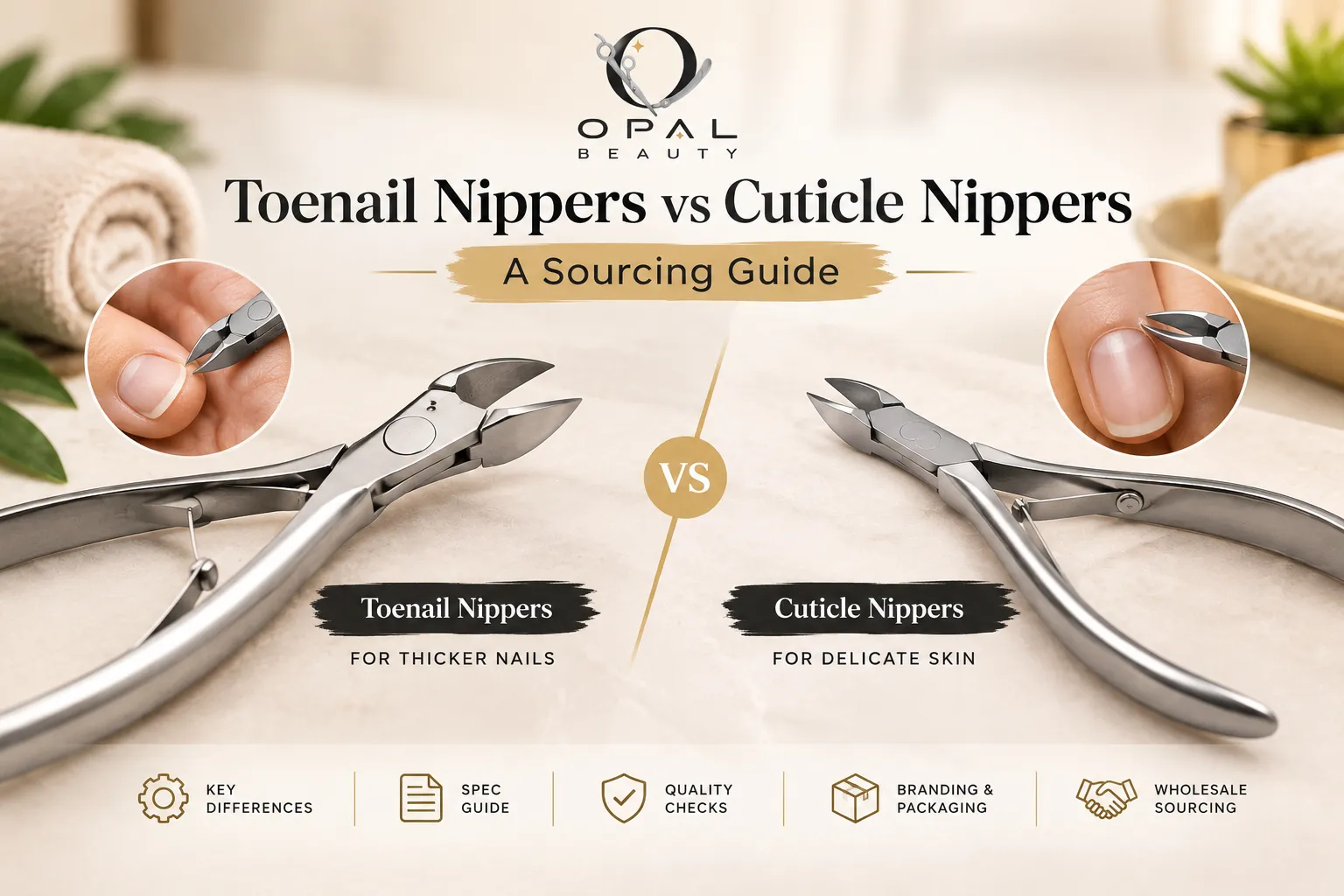

Two tools in a catalog can both be called “nippers” and still do very different jobs. A buyer who orders by name alone can end up with fine cuticle nippers when the salon needed toenail nippers, or the reverse. This guide compares toenail nippers vs cuticle nippers from a sourcing point of view: what each is for, how they differ on a spec sheet, how to name and label them so orders do not get mixed up, and what to check on samples.
It is written for salon chains, spas, distributors, and private label brands. General industry information is kept separate from what Opal Beauty states about its own range. Opal Beauty’s site lists cuticle cutters and nippers but does not list toenail or podiatry-style nippers, so confirm those with the team before you plan an order around them.
The Difference Between Cuticle Nippers and Toenail Nippers
What Each Tool Is For
Cuticle nippers are fine-jawed tools for the thin skin around the nail. Toenail nippers cut the nail plate itself, and toenails are often thicker and tougher than fingernails. The tools share a plier-style action, but the job decides the build. That is the core difference between cuticle nippers and toenail nippers, and every spec choice follows from it.
Why Buyers Mix Them Up
Product names are inconsistent. “Nail nippers,” “nail cutters,” and “toenail cutters” can each describe a cuticle tool, a nail tool, or a lever-style clipper, depending on the seller and the market. Never rely on the title alone. Ask for a photo showing the jaw, plus the jaw length and overall length in millimeters.
Side-by-Side Specification Comparison
| Feature | Cuticle nippers | Toenail nippers | Sourcing implication |
| Main job | Trimming skin around the nail | Cutting thicker nails | Name the product by job |
| Jaw | Fine and narrow | Wider and sturdier | Specify jaw length in mm |
| Build | Light, precise | Heavier, more rigid | Check weight and balance |
| Spring | Smooth return for small cuts | Stronger action for leverage | Ask for spring style |
| Typical station | Manicure | Pedicure | Stock by station |
| Risk if mismatched | Crushed cuts, damaged tool | Clumsy, hard to control | Label clearly |
Use the table as a starting point for your own spec sheet, then add the numbers your customers care about. Opal Beauty’s cuticle cutters and nippers page lists quarter, half, and full jaw sizes and several spring styles for cuticle tools. For jaw shapes and sizes on toenail styles, see our guide to toenail nipper jaw types and sizes.
Jaw and Edge Differences
A cuticle nipper’s edge is meant for small, controlled cuts. A toenail nipper’s edge must stay aligned under more force. That makes edge alignment the first thing to check on both, but it fails differently on each: a misaligned cuticle jaw bites poorly, while a misaligned toenail jaw crushes or splits the nail.
Handle, Spring, and Build
Handle length and spring strength change how the tool feels over a full day. A longer handle gives more leverage and less control, which suits thick toenails and not delicate cuticle work. Decide the handle length and spring style before you request samples, and write them into the spec.
Which Tool for Which Buyer
These are starting points, not rules.
- Manicure-focused salon: cuticle nippers at every station, plus scissors where preferred. Our guide to cuticle scissors vs nippers helps with that choice.
- Spa with pedicure services: both tools, kept separate by station. See our pedicure instruments wholesale guide for planning stock.
- Distributor: both, with clear names and photos so customers can tell them apart.
- Private label brand: one cuticle nipper first, then add a toenail style once you have confirmed it is available. Opal Beauty’s manicure and pedicure kits page covers kit options.
Planning an Assortment With Both Tools
Plan quantities by station, not by catalog. Cuticle nippers are used at manicure and pedicure stations alike, so they usually need the larger count. Toenail nippers are mainly a pedicure-station tool, so their count follows the number of pedicure stations and clients per shift. Add rotation stock for both, so tools can be cleaned and dried between clients. If you sell sets, decide whether the kit holds one nipper or both, and whether the two are clearly marked so a technician can tell them apart at a glance.
Naming, Labeling, and Packaging to Prevent Mix-Ups
Product Names and SKUs
Name each product by its job and size, for example “cuticle nipper, half jaw” or “toenail nipper, full jaw.” Put the jaw length in the listing and use a close-up photo of the jaw. Use different SKU codes, so a reorder cannot quietly swap one tool for the other.
Product Page Copy That Prevents Returns
Write the listing for the buyer who has never seen the tool. State the job in plain words, give the jaw length and overall length in millimeters with inches in brackets for US customers, name the finish, and show a close-up of the jaw. Say what is in the pack, and avoid medical claims. Clear copy reduces returns and support questions, and it keeps cuticle and toenail products from being bought for the wrong job.
Branding and Packaging
Use packaging and engraving to separate the two. A different sleeve color, a printed job label, or engraved text on the handle all help. Our guides to logo engraving and branding options and custom packaging explain the choices, and the private label and custom branding service covers the overall process.
Sample Checks for Each Tool
Both tools need careful sample approval, and the checks differ. Our quality control checklist gives a fuller routine.
Checks by Tool Type
Cuticle Nippers: Precision Checks
For cuticle nippers, precision is the priority: tip closure, edge sharpness, and a smooth, even spring return.
Edge and Tip Alignment
The cutting edges should meet cleanly along their full length, with no gap at the tip.
Close Under Light
Hold the nipper to the light and close it slowly. Any light visible between the edges points to alignment trouble.
Toenail Nippers: Strength Checks
For professional toenail nippers, check that the jaws stay aligned under pressure, the joint feels rigid, and the handles are comfortable over repeated cuts. A joint that flexes or shifts is a warning sign.
Common Mistakes When Sourcing Both Tools
- Ordering by title alone: “nail nippers” can mean several different tools, so check the jaw.
- Using one spec for both: a fine cuticle spec and a sturdy toenail spec are different documents.
- Skipping close-up photos: the jaw is the clearest sign of what the tool is.
- Approving one tool and assuming the other: sample each model you plan to stock.
- Letting packaging blur the line: identical packs invite picking errors in a busy salon.
- Ignoring the reorder check: compare later batches against the approved sample of each tool.
Steel, Finish, and Care
Ask which steel and finish each model uses, since a heavier tool may be built differently from a fine one. Our guide to stainless steel for nail instruments explains the questions to ask. For tools that will be reprocessed, ask for written care instructions and read our guide to sterilization pouches and autoclave-safe tools. Rules for cleaning and disinfection differ by region, so follow local regulations and the manufacturer’s instructions.
Ingrown Toenail Nippers and Podiatry Nippers
Names like ingrown toenail nippers and podiatry nippers are marketing labels, not standard categories. Whether a salon may work on such nails depends on local rules and training, and these cases often belong with a foot-care professional. Avoid medical claims when you list or promote either tool. Our toenail nipper guide covers this scope question in more detail.
Selling Both Tools Across Different Markets
Terminology shifts between markets. “Nail cutters” and “nail clippers” are used differently in different places, so test your product names with local partners. US buyers can start with the USA beauty instrument supplier page. Buyers in the UK and Germany may expect clear product naming and documentation, and the full list of markets covers the rest. These are general observations, not rules.
Sourcing Both Tools From a Factory-Direct Manufacturer
Buyers ordering from overseas ask about samples, design approval, batch-to-batch consistency, packaging, shipping, and customs. Settle them in writing before production. Import and compliance requirements differ by country and change over time, so confirm them locally.
Opal Beauty is a factory-direct manufacturer in Sialkot, Pakistan, with wholesale and bulk supply for brands and distributors. Ask whether minimum order quantities apply per product, per finish, or per order, and whether combining both tools in one order changes the terms. For a broader view of assortment planning, read our professional nail care tools wholesale guide.
What to Include in Your Quote Request
- Which tool you need: cuticle nipper, toenail nipper, or both
- Jaw length and shape, overall length, and spring style
- Finish, branding files, and packaging format
- Quantity per product, destination country, and delivery window
Request a quote with those details so each product is specified separately.
Frequently Asked Questions
Can cuticle nippers be used on toenails?
They are not built for it. Fine cuticle jaws are made for delicate skin, and toenails need a sturdier tool. Using the right tool for each job gives better control.
Are toenail nippers the same as toenail clippers?
Not always. Nippers are plier-style, while clippers are usually lever-style. Sellers use the terms loosely, so confirm the design from a photo.
Should a salon stock both tools?
Most salons that offer manicures and pedicures benefit from both, kept at the right stations.
How can I avoid mixed-up shipments?
Use different SKUs, clear product names, a close-up photo of the jaw, and different packaging or engraving for each tool.
Does Opal Beauty make toenail nippers?
Its site lists cuticle cutters and nippers but not toenail or podiatry-style nippers. Ask in your quote.
Final Thoughts: Name the Job, Then Write the Spec
Decide which job each tool does, write the jaw and handle spec for it, and label it so it cannot be confused with the other. Approve samples against a reference. A clear spec for each tool is the best protection against the wrong one arriving.